
|
    Professional Email Marketing Solutions |
20 Tips for Dramatically Better Emails
Our experts came across these previously published articles we thought you would find useful.
These are re-posts from the original sources. Author: getvero
When it comes right down to it, email marketing is all about getting the basics right.
Yes, you need to segment your lists and yes, you should upgrade your transactional emails but every email marketer also needs to invest time in big picture strategies like positioning, voice, value and conversion optimization. The 20 tips below may seem basic but you'll find many at the core of the best email marketing campaigns out there. You'll notice that many of the examples employ five or more of these tips in a single email. For best results, apply liberally.
For easy reference, you can also download these examples as a swipe file.
Tip 1 Create an exclusive club
Making your email subscribers feel special is a great way to generate excitement for the content or offers you are sending them and it's a powerful community building tool.
Exclusivity can be subtle, like the Apple example below, or it can be overt, like Groove.
Whenever Apple launches a new product, customers camp outside their stores to get their hands on the latest device. By offering a pre-order, Apple can cash in on that excitement without putting additional stress on their retail stores. With free shipping as an added incentive, these emails will no doubt drive huge sales before the iPhone 6 is even released. (Within three days of the launch, Apple had sold 10 million phones.) 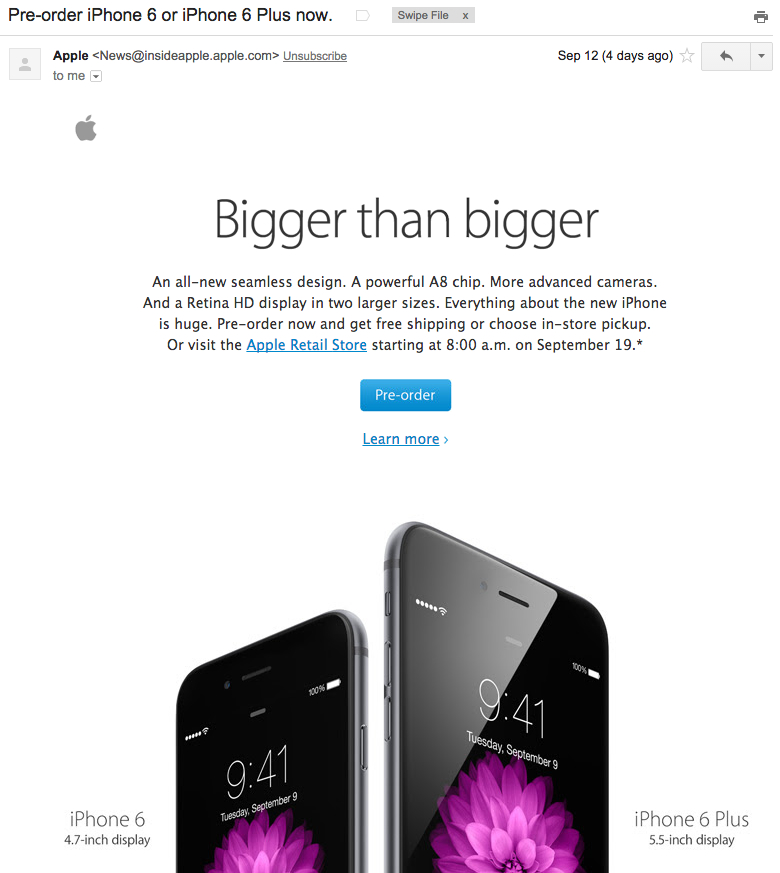
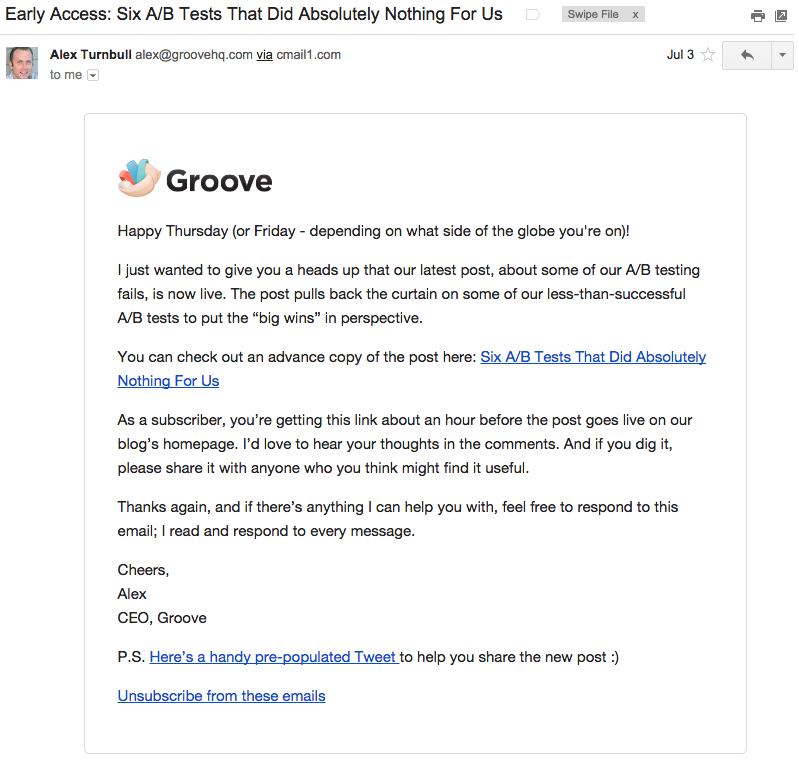
Groove's Alex Turnbull takes a more direct approach. He emails new posts out to blog subscribers before they are available to people who read via RSS feeds or social media.
"As a subscriber, you're getting this link about an hour before the post goes live on our blog's homepage."
Each email he sends begins with the words "Early Access".
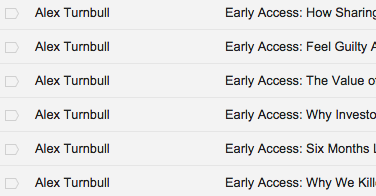
It makes email recipients feel like they are part of an exclusive club because, well, they are! Over the course of that hour, Alex can collect feedback and make any changes he feels would improve the post as more people see it. We asked Alex about the strategy. Here's what he had to say:
The early access emails help us build a better relationship with our readers. It's a value-add on top of just getting the content each week. I've heard from dozens of folks who appreciate the exclusive look at new content before we release it, and we even see people urging others to sign up because of that benefit.
One thing I'd encourage every blogger to do is to keep yourself in your readers' inboxes on a regular basis. In our early days, we'd email sporadically. Sometimes it was once a week, other times people didn't hear from us for 3-4 weeks in a row. The emails we sent after lapses like that almost always had lower open rates and higher unsubscribe rates than the previous email.
Now, we send emails every single Thursday. It gets people used to hearing from us, and our open rates are higher because of that. Even if you're not writing new posts each week, you can still send useful emails to maintain that relationship.
The early access emails help us build a better relationship with our readers.Alex Turnbull, GrooveHQ
Tip 2 Show that you care
Your email subscribers getting dozens, if not hundreds, of other emails every day. They are constantly being asked to start a free trial, download an e-book or follow someone on Twitter.
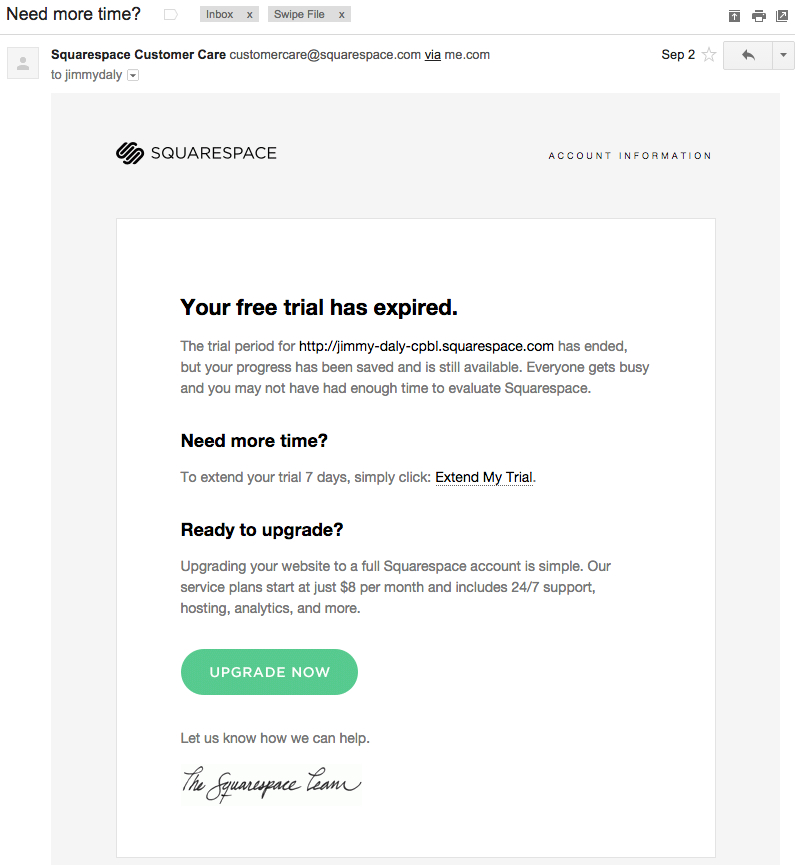
There's an overwhelming amount of noise in the inbox. Showing your recipients that you care goes a long way towards earning their trust. In this example of Squarespace below, they take a friendly approach to urgency. False emergencies – "LAST DAY TO SAVE!!!" – comes off as desperate. Squarespace acknowledges the reality of our busy lives and offers a chance for an extended trial.
Everyone gets busy and you may not have had enough time to evaluate Squarespace.
Buffer's Kevan Lee told us that his best email advice is to "Delight your subscribers". Dropbox took that advice to a new level with this email. They gave me 10x the storage space for the same price! Do you think I'll open the next email they send? You bet.
- We're giving you 10x the space – for the same price. You'll have 1 TB of space for your photos, videos, docs, and any other files you want to keep safe in Dropbox.
- With new sharing controls, we're making it easier to manage access to the stuff you share. You can set passwords and expiration dates on your shared links and grant view-only access to shared folders.
- Keeping your stuff safe is our top priority. For extra peace of mind, remote wipe lets you delete your Dropbox files off a lost or stolen device.
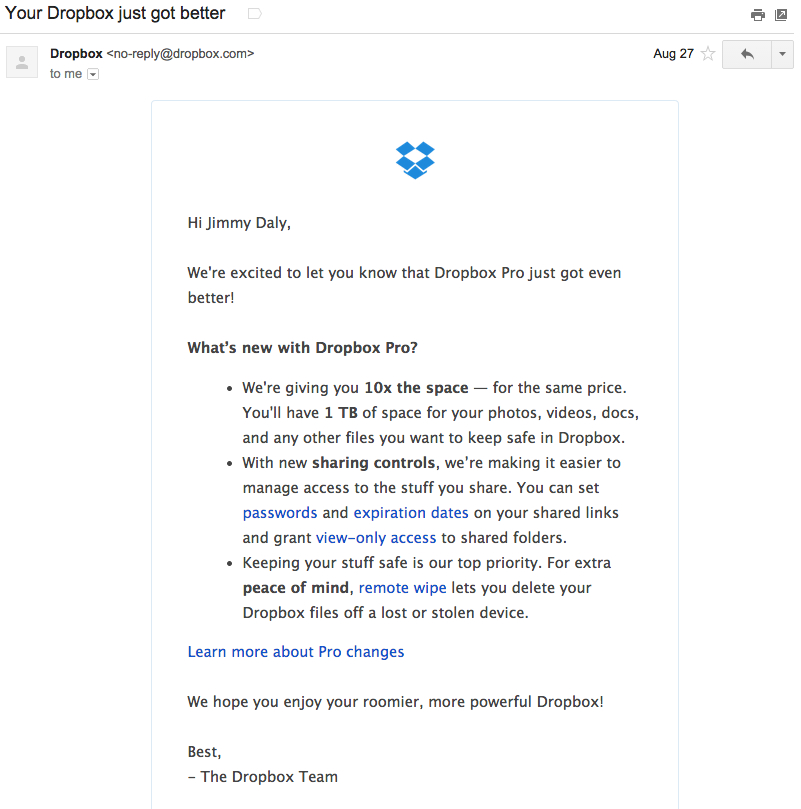
Of course, this a major business decision, not just an email marketing tactic but the decision reflects Dropbox's mission as a company: to make their customers happy. Email is just an extension of their core beliefs.
Thanks Dropbox. 🙂
Tip 3 Ask for feedback
As long as you aren't pushy, it's okay to ask for help.
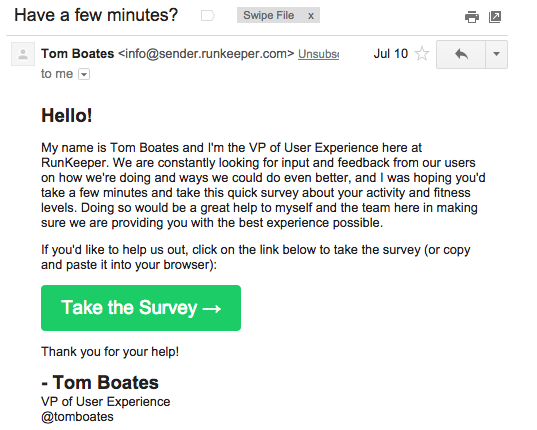
I get lots of emails from RunKeeper but this is the first from Tom Boates, the company's VP of User Experience. This is an interesting way to help users get to know the company they are supporting and it could also help users get a better product in the future.
"Doing so would be a great help to myself and the team here in making sure we are providing you with the best experience possible."
If you ask for help, be genuine and people will respond.
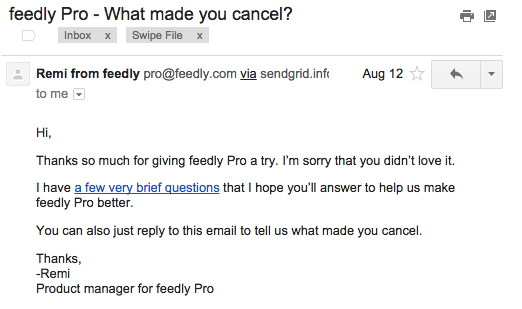
Feedly takes a similar approach by introducing me to someone new in the company. They aren't begging me to come back, they are simply asking what led to the cancellation. The company has earned a reputation for being trustworthy and innovative, so I was happy to offer candid feedback.
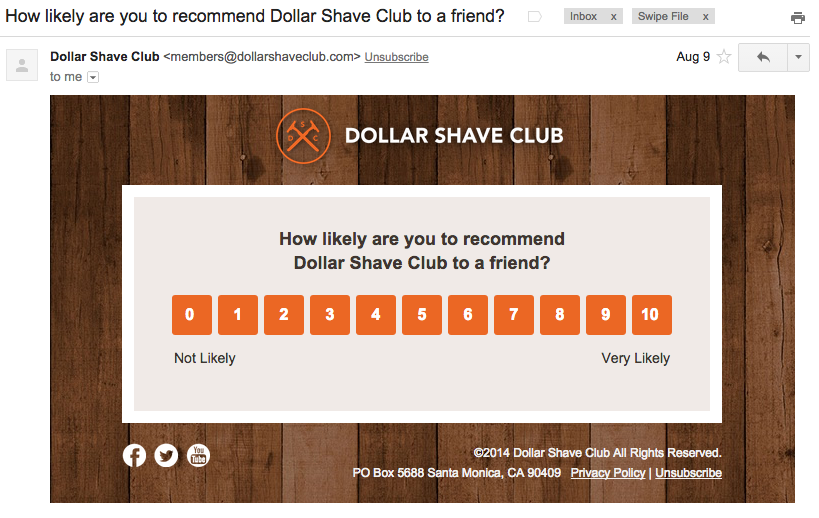
If you are going to ask for feedback, you need make it dead-simple. Dollar Shave Club, as we've written before, is driven by experience. The subscription is easy, the blades are good and the marketing is captivating. Everything about Dollar Shave Club is a pleasure, including their survey emails.
The easier it is to leave feedback, the more people will do it.
Tip 4 Use social proof
From the KISSmetrics blog:
Social proof is the reason sites like Yelp continue to thrive. Consumers trust what other consumers think. The same principle can easily be applied to email marketing. It's best used subtly, as you don't want to toot your own horn.
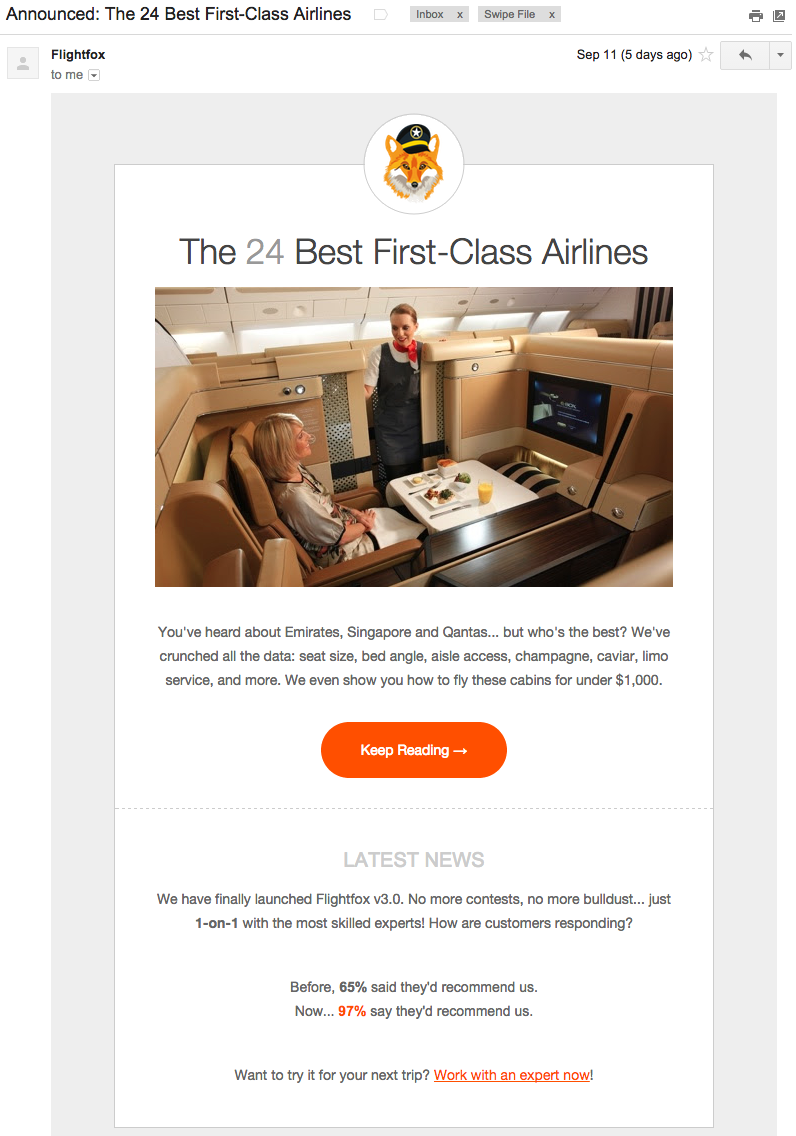
Look how FlightFox casually mentioned that 97% of customers would recommend the latest version of the service. That's a stunning number, and it's included in an email about a new blog post.
If you have a number like that to share, make sure everyone knows about it.
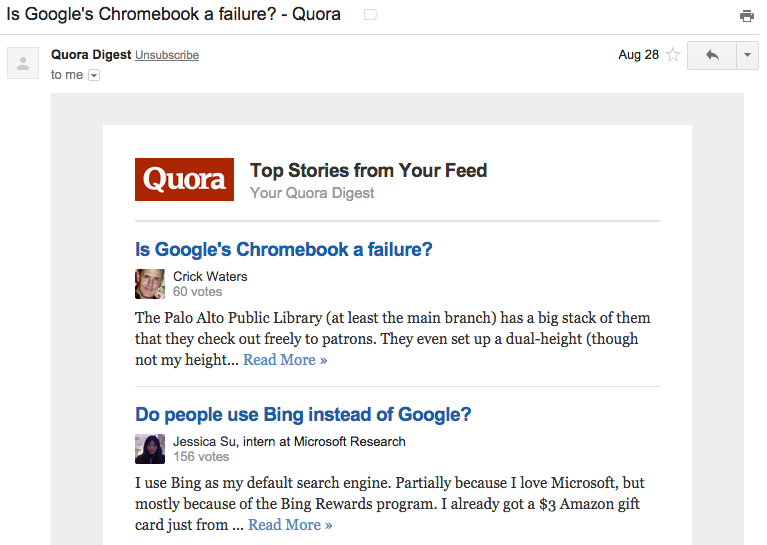
Many forums and communities take full advantage of social proof. Because they have active users, they can parlay engagement into more engagement. Quora, who we'll discuss more in this post, does this beautifully. Readers can use the number of votes on a discussion to decide which link to click.
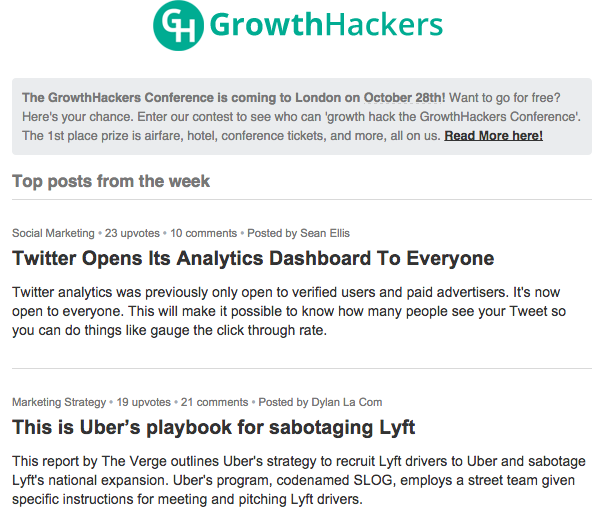
GrowthHackers takes a similar approach but with even more emphasis on their users' activity. If a GrowthHackers discussion has 20 comments, you know there is good information being passed around.
If you don't have a forum, consider including social share numbers in your newsletters. The effect is the same – readers want to know what their peers are interested in.
Tip 5 Get personal
"Only strong people are comfortable talking about their failures."Hayes Drumwright, CEO of Trace3 (a $300 million company)
Email is a good opportunity to humanize your brand. The inbox is a intimate place, mostly used for personal conversation. Your presence there is a privilege, so do your best to write like a human. It's okay to talk about challenges, obstacles and even failures. Readers can relate since they are likely facing similar situations with their own lives and businesses.
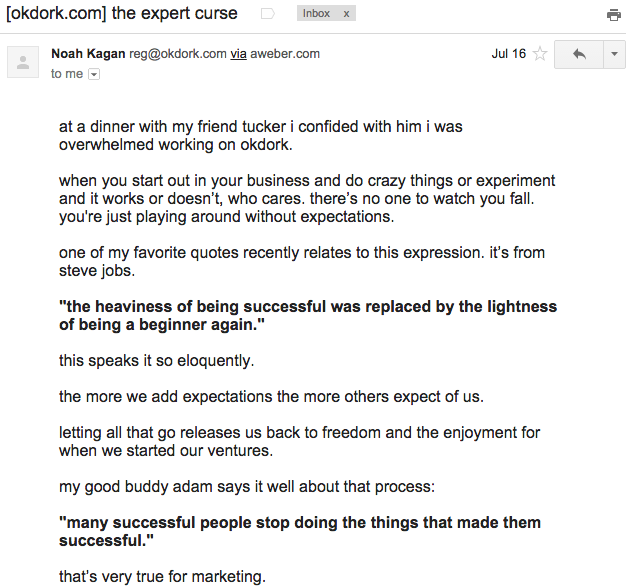
In the email below, Noah Kagan discusses a very personal conversation he had with a friend about his blog. How many marketers have ever felt overwhelmed with their work? All of them!
The post goes on to offer some ways to deal with the challenges of growing a blog. Identifying a pain point, then offering a solution is an age-old strategy that's still effective today.
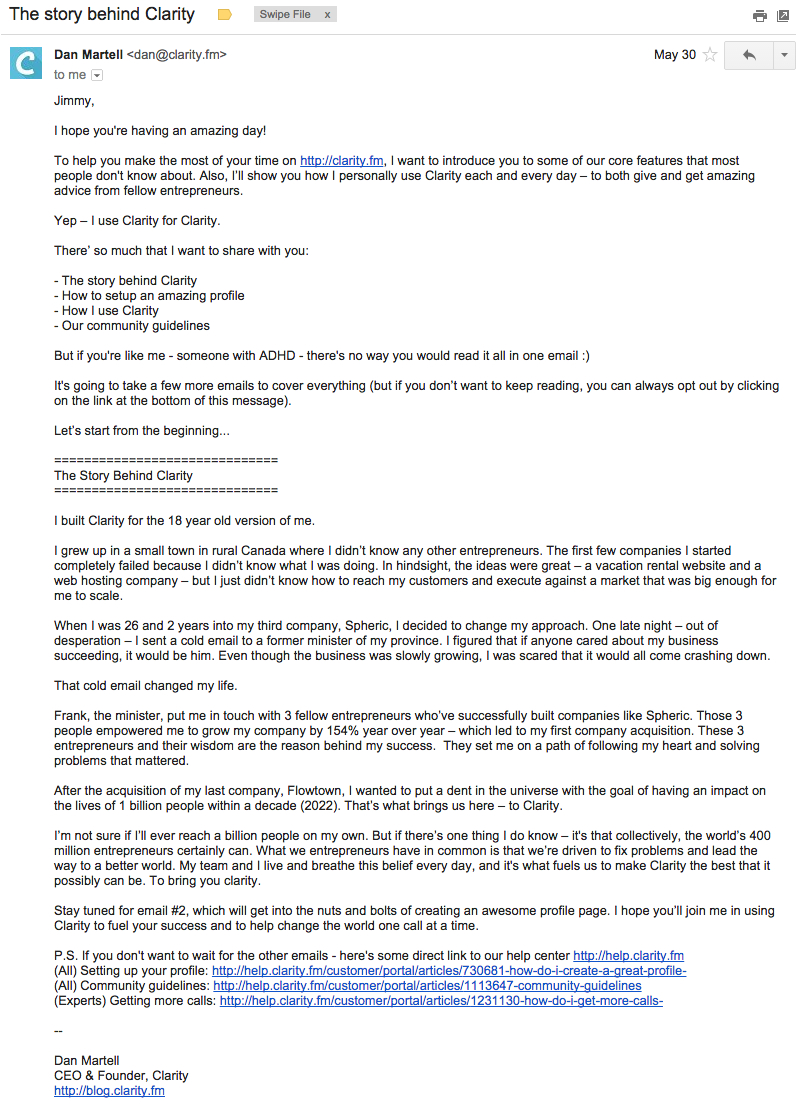
Clarity, a service to help entrepreneurs and marketers grow their business, takes a different approach by telling the story of their own company. The tactic is different but the strategy is the same: relate to the same pain points as the user and offer solutions.
The first few companies I started completely failed because I didn't know what I was doing. In hindsight, the ideas were great – a vacation rental website and a web hosting company – but I just didn't know how to reach my customers and execute against a market that was big enough for me to scale.
When I was 26 and 2 years into my third company, Spheric, I decided to change my approach. One late night – out of desperation – I sent a cold email to a former minister of my province. I figured that if anyone cared about my business succeeding, it would be him. Even though the business was slowly growing, I was scared that it would all come crashing down.
That cold email changed my life.
Tip 6 Make conversion a habit.
Recently I was chatting with David Sherry, co-founder of Death to the Stock Photo, about his company's email strategy. They've grown their business almost entirely with email – we'll look at an example later in this post – and he offered some magical advice:
Make conversion a habit.
It's simple but seriously profound. He builds opportunities for small conversions into every email so that people get used to converting. This can be as simple as "Follow me on Twitter" or as significant as "Upgrade your account".
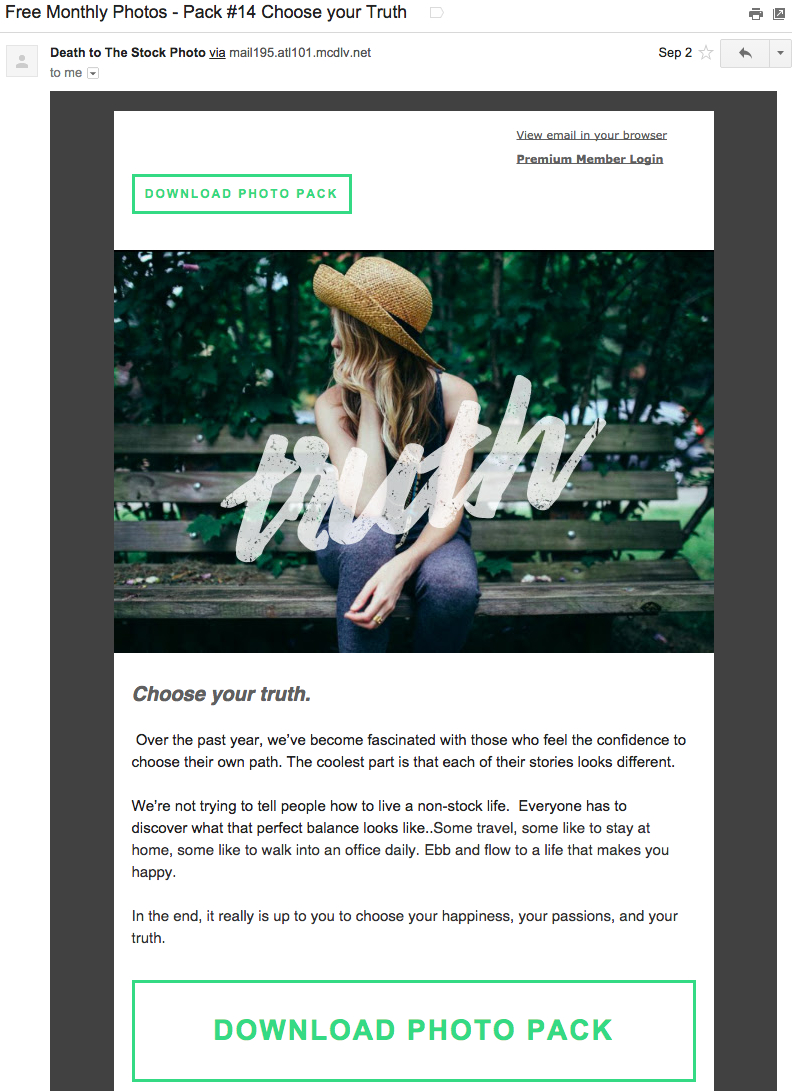
In David's case, they include free stock photos in each email which can be downloaded. People are used to clicking his emails because there is always value in converting.
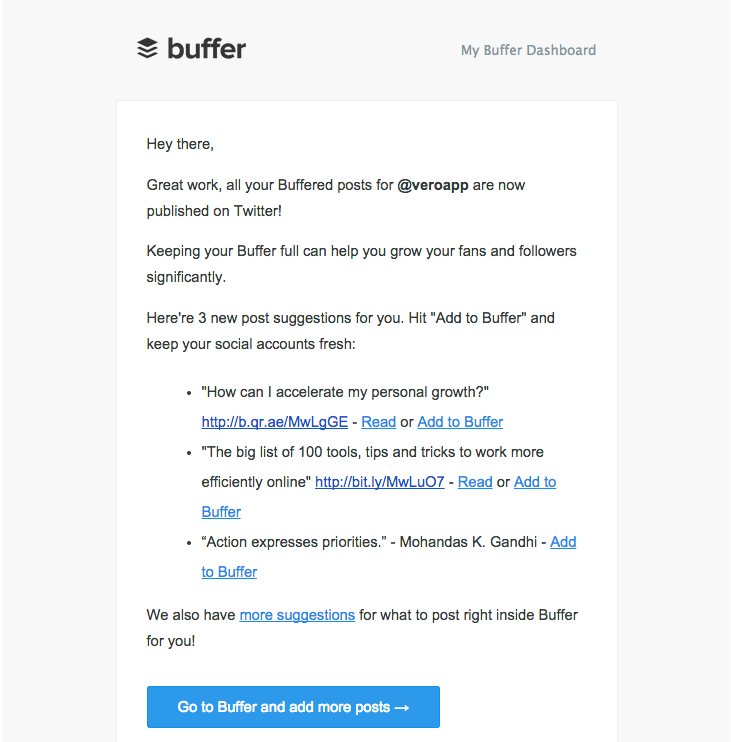
Buffer is great at this too. In the transactional email below, they are aiming for a small conversion: user engagement with their app. By creating pre-made tweets, they make it as easy as possible for the user to convert. The conversion doesn't directly result in revenue, but it does get users in the habit of 1) clicking their emails and 2) using the app.
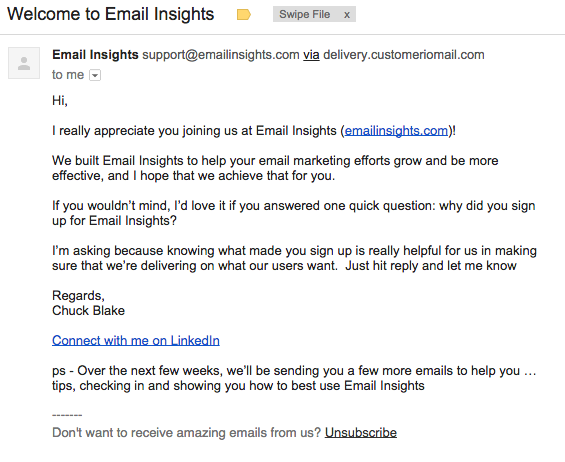
EmailInsights builds in even smaller calls to action. In the email below, they are looking for feedback on their product but also ask the user to connect with the founder, Chuck Blake, on LinkedIn.
Again, the conversion doesn't directly create revenue but if the user does it, they will be exposed to more content from Email Insights and they can get a feel Chuck's experience and personality.
Tip 7 Include downloads
The number of emails sent and received with attachments increased 43% on daily basis percent from 2009 to 2013, according to Radicati. During that same period, emails without attachments increased by 27%.
Why?
Email is the perfect platform to exchange files.
Marketing emails usually don't contain files – the focus is on messaging, calls to action and design. Why not add some utility to your emails?
As discussed above, Death to the Stock Photo does this beautifully. They only send one email per month but each contains a downloadable file of stunning "non-stock" images that you can use on your blog or in your email.
Their emails delight users not only because of the stylish design but because of their utility. This email empowers the user to take action and the habit-forming nature makes it easier to ask users to upgrade to their premium level.
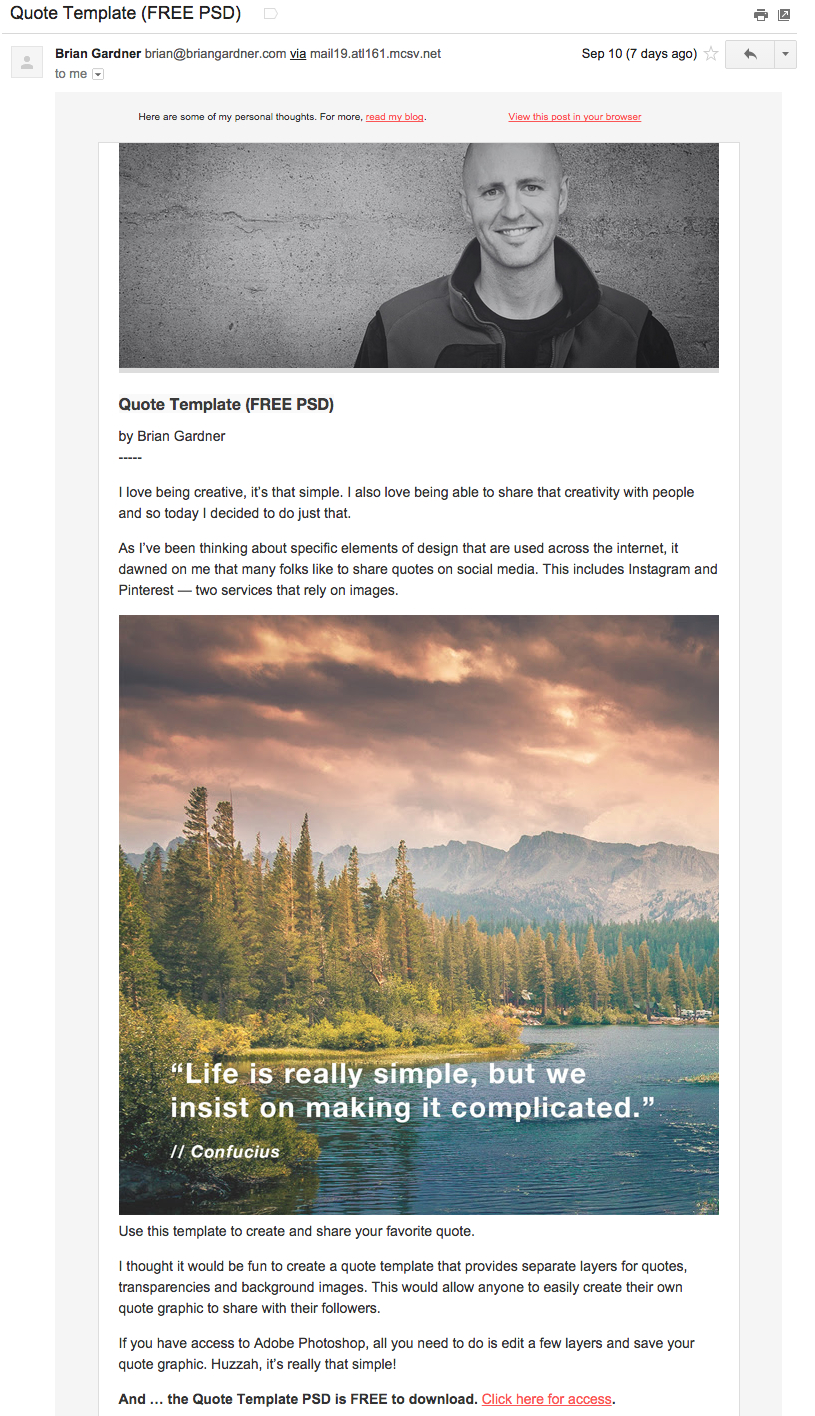
Brian Gardner developed the WordPress Genesis Framework along with a number of themes and code snippets. His newsletter often contains free downloads that you can use spruce up your WordPress site. (The share buttons we are currently using were created by Brian.)
I love getting Brian's email because I know they contain real value. Regardless of the subject line, I open Brian's emails because he consistently delivers utility.
Tip 8 Tell readers what to do next
The cardinal sin of conversion is failure to make the next step adundantly clear. How can someone convert if they aren't sure what to do?
Conversion Rate Experts stress this over and over again:
Be clear and direct with your users, telling them exactly what you'd like them to do.
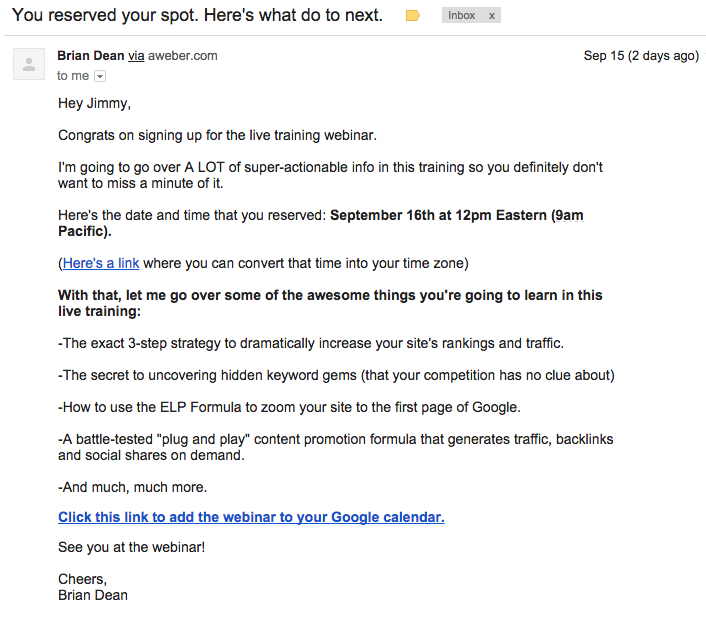
Look how seriously Backlinko's Brian Dean takes this advice. This email was sent immediately after registering for a webinar and he, quite literally, tells me exactly what to do next.
The idea is simple: just add the the webinar to your calendar. Not only does this reinforce the behavior pattern of clicking Brian's emails but it also increases the chances that the registrants actually attend the webinar. Once it's on the calendar, they will get alerts from their phone and/or computer … it's like free marketing.
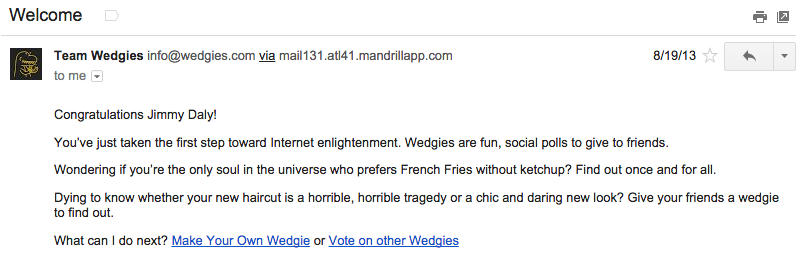
Answering the question "What should I do next?" is also a great way to boost engagement with a SaaS app. Wedgies, a tool for creating social polls, sent me this email right after I registered. Without a nudge in the right direction, you risk losing users before they ever have a chance to experience your app.
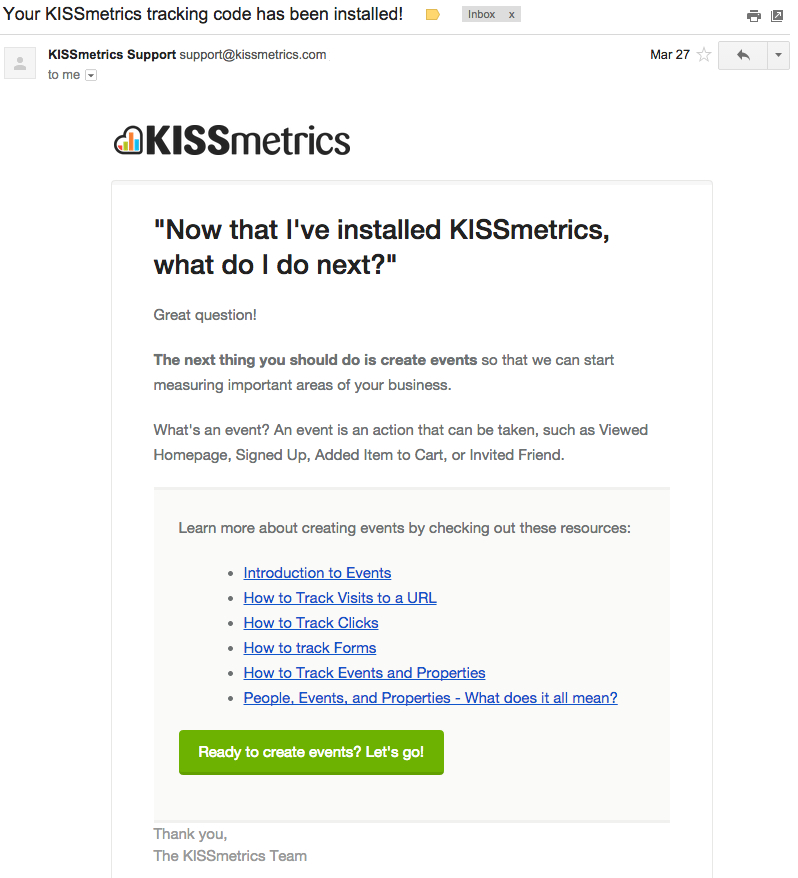
In KISSmetrics' case, a new user has to take a next step or they won't get any value from the tool. Clearly, they've heard this question before, which is why the present it in bold text and in quotations, as if the reader is asking it out loud. They keep the language very simple, then present a button, with a contrasting color and friendly copy, to move the user onward.
The next thing you should do is create events so that we can start measuring important areas of your business.
Tip 9 Keep readers on their toes
This tip is unconventional but proven to work.
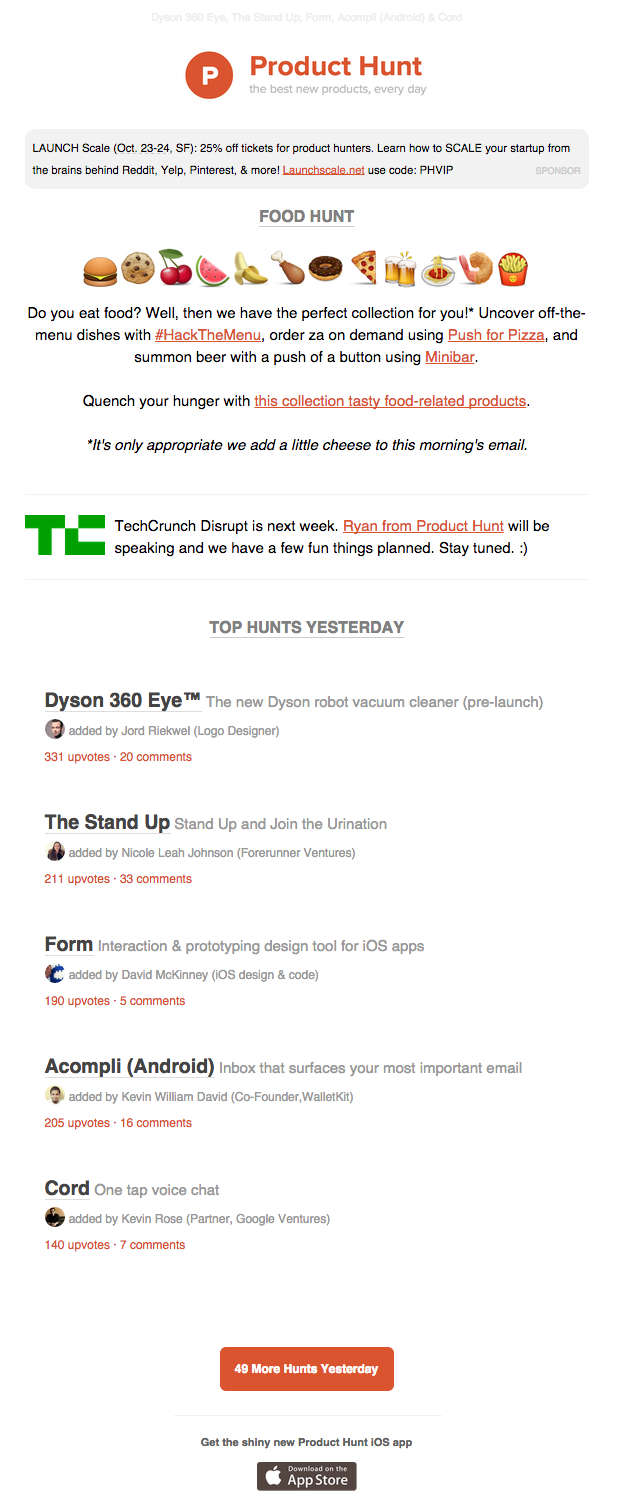
On one hand, you want your readers to know what to expect in your emails. In HelpScout's case, that means a great blog every Wednesday without fail. In ProductHunt's case, that means five new products every day. The user never knows what those products will be but they have come to expect value from these emails, which is why they are opened at such a high rate.
ProductHunt is a email-first startup, meaning that it started as a newsletter and later grew into a website, podcast and mobile app. While it might sound counterintuitive to keep readers on their toes, the strategy has been proven by ProductHunt as well as other companies, like Timeop and iDoneThis.
First Round Review published a detailed account of ProductHunt's growth which we highly recommend checking out.
"Even though the email was super basic, it gave me validation that people cared about this content," says Hoover. And when he eventually decided to build the site, the email list became the most important asset and springboard for driving traffic and keeping people coming back again and again. It's continued to swell as Product Hunt has gained momentum, a constant source of new fans and marketing opportunities. Today, the email list tops 43,000 subscribers.
Now, the examples.
ProductHunt goes big on email. Every email they send is loaded with new apps, tools and products that are validated with social proof. You never know what you are going to get but you always know it's going to be something really good.
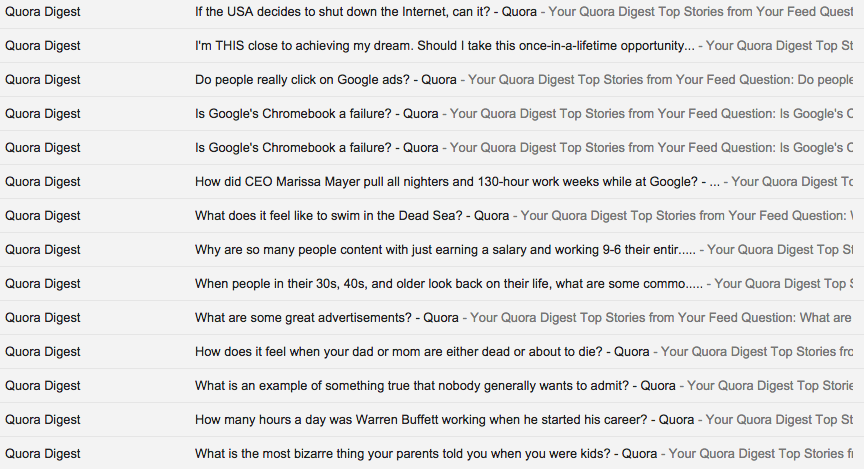
Quora's emails are like a box of chocolates … you never what you're gonna get next. Here are some recent subject lines from Quora digest emails. They are borderline random and range from bizarre to practical, but they are always intriguing.
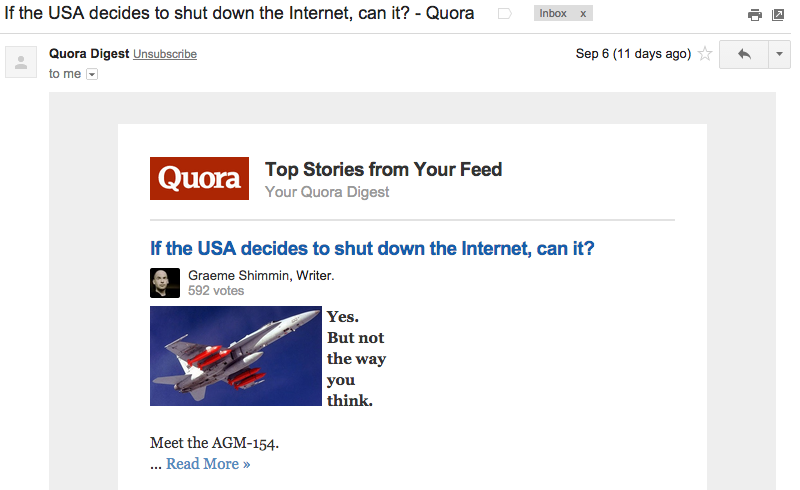
This strategy is easier when you have user generated content like Quora and ProductHunt. Quora also employs social proof in their emails to validate the quality of the links they include.
Tip 10 Use the same subject line every time
This is another tactic that might be considered unconventional but it's actually very effective if your users trust you and your brand. It's a good idea to do this with transactional emails, like receipts, to make it very easy for users to find and reference them. But the tactic can be useful for newsletters and marketing emails too if you send them on a daily, weekly or monthly basis.
Remember, you want your recipients to look forward to your emails so much that it doesn't matter what the subject says.
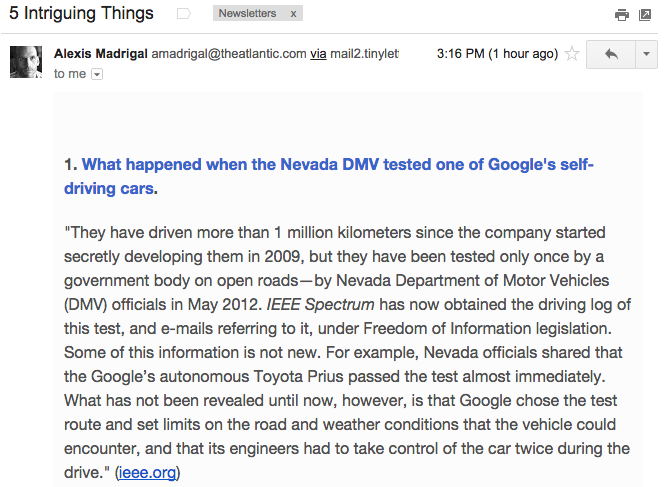
Alexis Madrigal sends his newsletter, 5 Intriguing Things, every single business day.
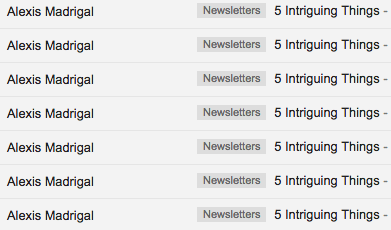
That's a lot of emails and it would be a struggle to come up with a new subject line every single day. More importantly, thought, Alexis' newsletter is highly anticipated by its recipients so the subject line doesn't matter. It's delivery each morning is familiar but still exciting.
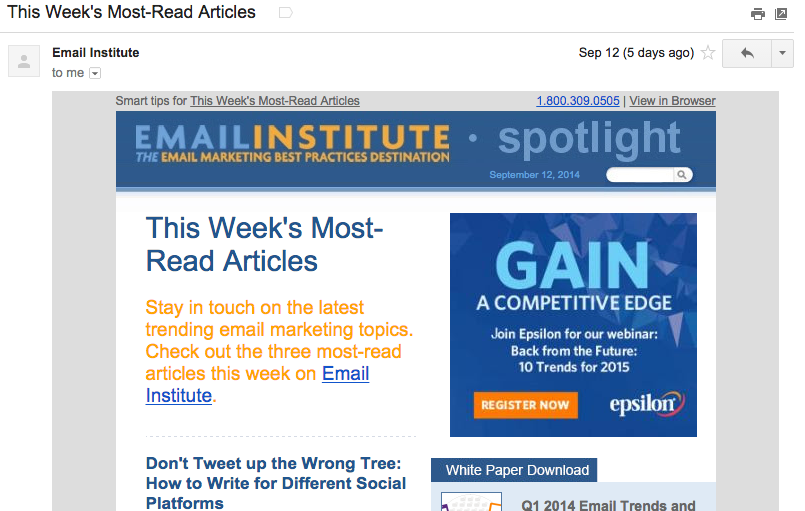
The Email Institute does this for their weekly email newsletter as well.
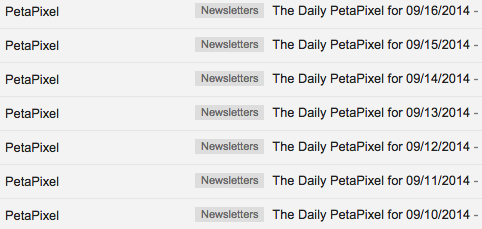
PetaPixel, who sends a massive daily newsletter, does this but appends the date to each newsletter to make it easy for readers to keep track of them.
Tip 11 Use referral codes
Referral codes work because everyone wins: the referrer, the referree and the business.
According to ReferralCandy, 83% of satisfied customers are willing to refer a product or service but just 29% actually do. If you can motivate them to refer friends and family, it's makes conversion a breeze: 92% of consumers trust referral over ads.
Adding referral codes to your emails is one way to turn every email into a sales opportunity.
Uber kills this. This is the footer of every Uber receipt (and here's a more detailed look):
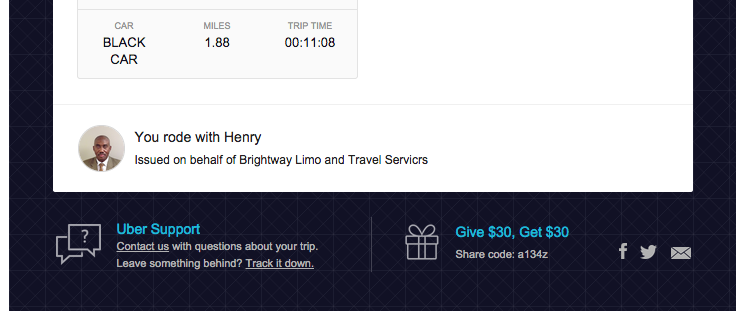
Refer a customer and you get an email like this. Not only is it fun get credit towards your next ride, but Uber is reinforcing the behavior by asking you to do it again. It's a super smart strategy that has helped Uber grow fast:
95% of all our riders have heard about Uber from other Uber riders. Our virality is almost unprecedented. For every 7 rides we do, our users' big mouths generate a new rider.
Simply amazing.
Dollar Shave Club puts even more emphasis on referrals in their emails:
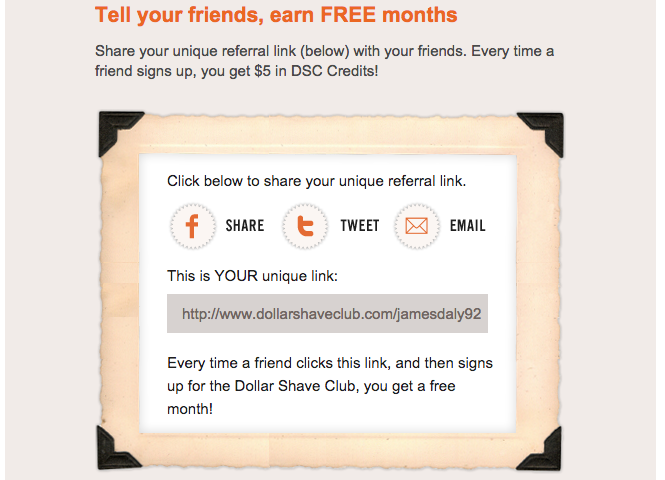
Why would anyone not do this?
Well, you must have complete confidence in your brand to attempt to turn customers into salespeople. They, in turn, must be confident enough in your product to tell friends and family about it. If your product rocks, including referral codes in your emails is a no-brainer.
Tip 12 Use buttons
Here's the simplest email marketing advice you'll ever receive:
If you want people to click, use buttons.
There are plenty of case studies on the topic. Campaign Monitor, for example, got a 28% increase on click-thrus when they A/B tested emails with and without buttons.
When it comes to writing copy and designing buttons, we always refer to conversion expert Joanna Wiebe:
What should my button say? A great rule of thumb when writing a call to action is to make your button copy complete this sentence: I want to ________________ What should my button look like?
- A 3D effect
- A contrasting, non-grey color
- Feedback on hover (e.g., different color)
- Whitespace around it
- An arrow pointing to it with instructional copy
Examples of this email marketing are abundant but here are few designs we really liked.
This Evernote email employs soft colors and encouraging language. It tees up the call to action by explaining why Evernote is so powerful before coming on strong with a bold, green button.
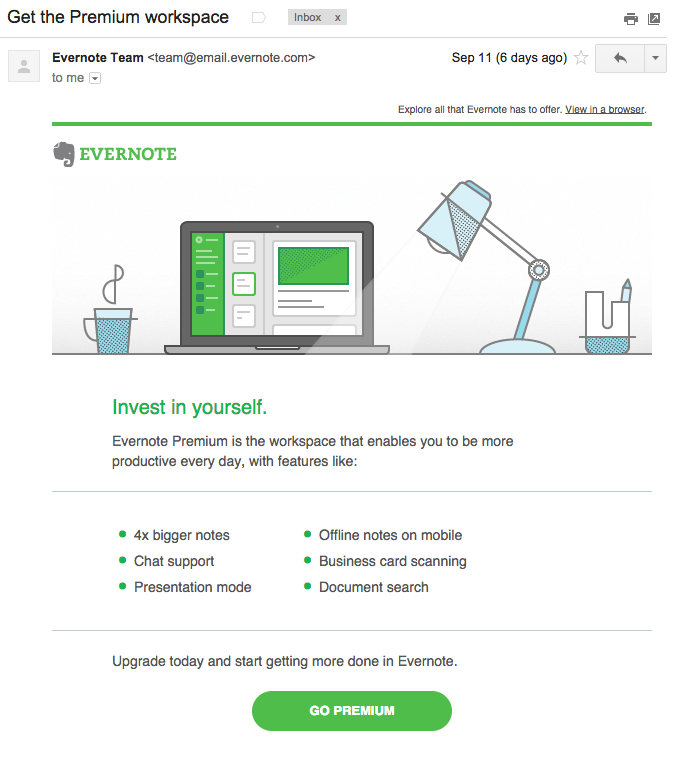
In this example from CreativeLive, there is no mistaking what they want you to do. The call to action is bold, simple and direct.
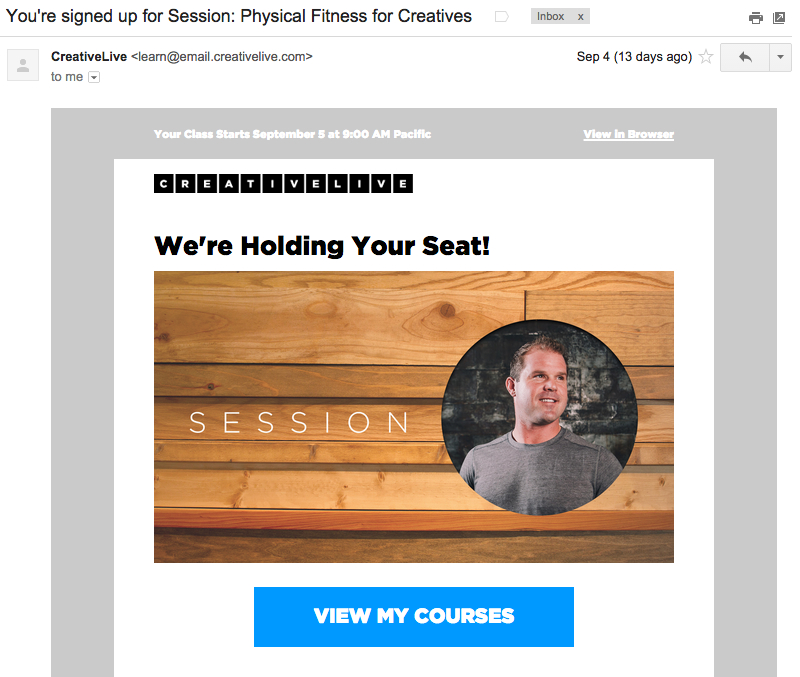
Tip 13 Overwhelm users with value
Good examples of this are too massive to include as screenshots. Click the links below to see them.
Impressive, right?
The first thing we should say about these emails is that they aren't for everyone. The second thing we should say is that they are for someone.
Think very carefully about your niche before creating and sending an email this massive. Here's why these emails work for their respective audiences:
- In PetaPixel's case, they are appealing to hardcore photographers, people that eat, sleep and breath gear, software and reviews. The more, the better.
- TucsonTopia is strictly a local publication. Their weekly email is super valuable because it contains tons of information about timely local events.
- Brain Pickings is a different kind of beast. Every email is an intellectual adventure. Maria Popova pours her heart and soul into it and has grown a massive audience as a result.
Again, not for everyone it's something to consider if you think your audience would embrace it.
Tip 14 Remind readers what you do
When we asked Belle Beth Cooper for her best email advice, here's what she told us:
Don't expect people to remember what you do – it's your job to remind them, every time. Every email we send about Exist, whether it's to existing users or people who signed up for our mailing list months ago, includes a link to remind them what Exist is. And that link gets clicks every time.
It's almost too simple. When we checked out the emails from her budding startup Exist, we found she does exactly that.
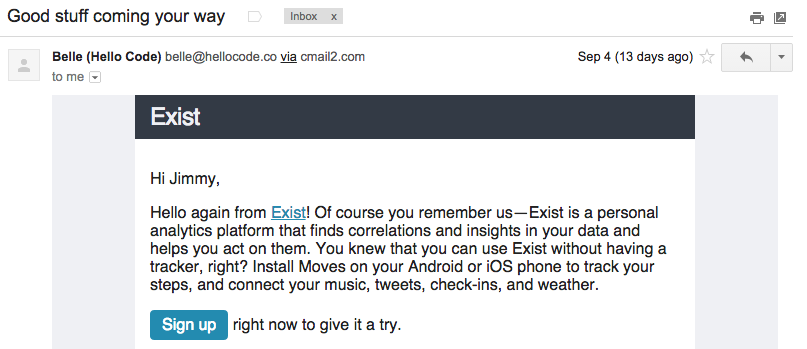
This is probably the simplest advice in the blog post and there is nothing to lose by implementing it immediately. Don't overlook the little things.
Tip 15 Leverage your partners' brand power
If your product or service integrates with other products or services, you are sitting on top of a gold mine of brand power. Leveraging the power of other brands is a great way to accelerate the authority of your own.
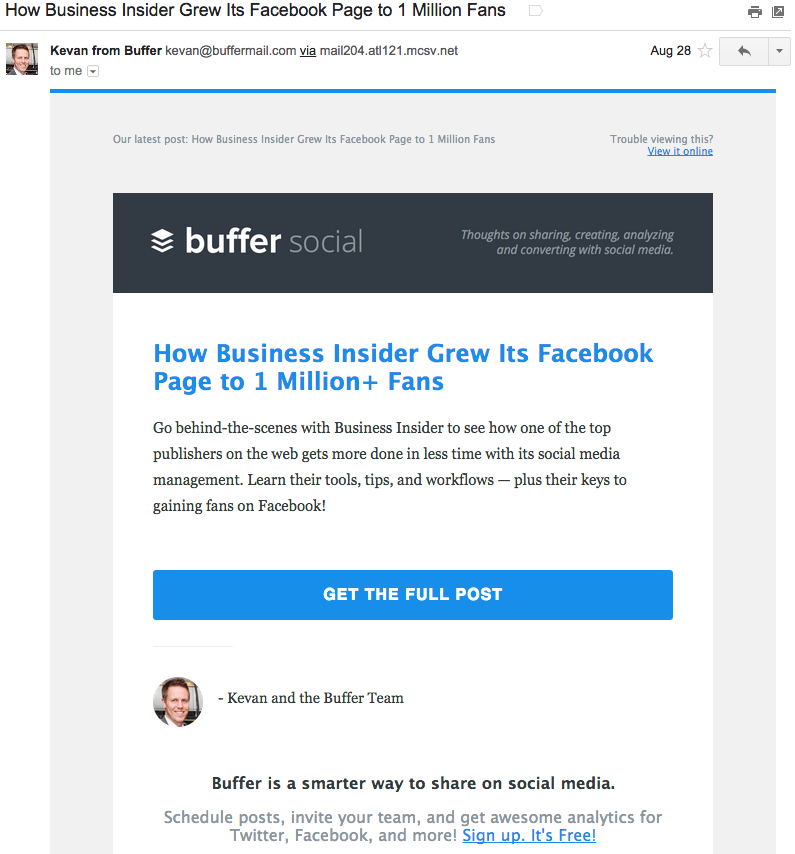
Lately, Buffer has been creating case studies of some of their biggest customers and using the results as a tool to appeal to enterprise customers. In the example below, they show how Business Insider grew their Facebook presence and although the content reads like a testimonial, it still contains valuable tips for Buffer users.
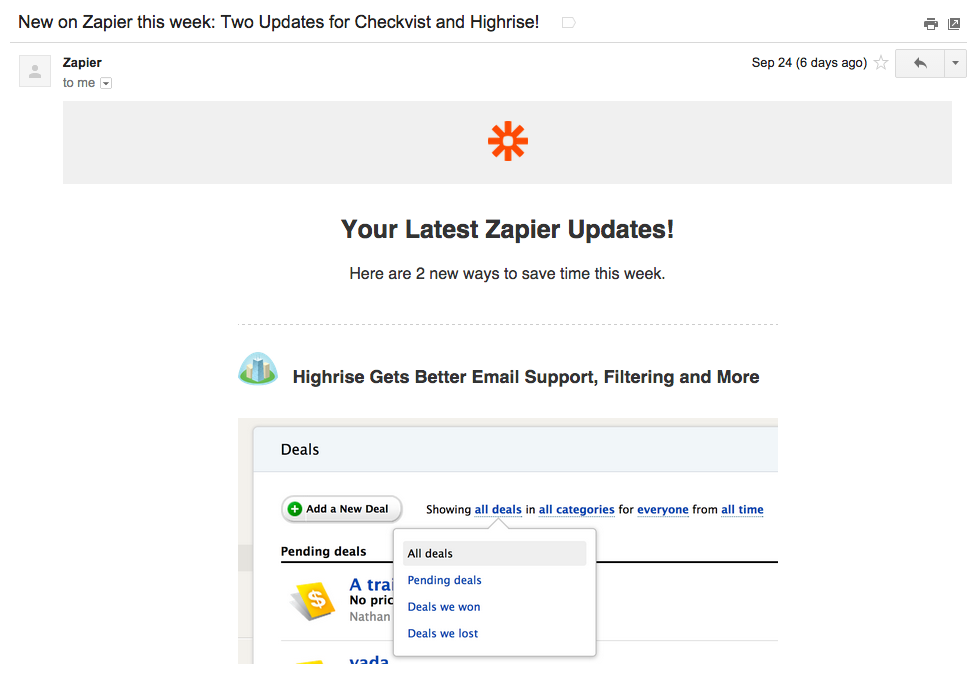
Zapier and IFTTT, services that rely almost entirely on partners to attract users and grow, emphasize other powerful brands in most of their emails.
In Zapier's case, Highrise integration adds valuable utility to any of their users who also like Highrise. It makes both services more valuable.
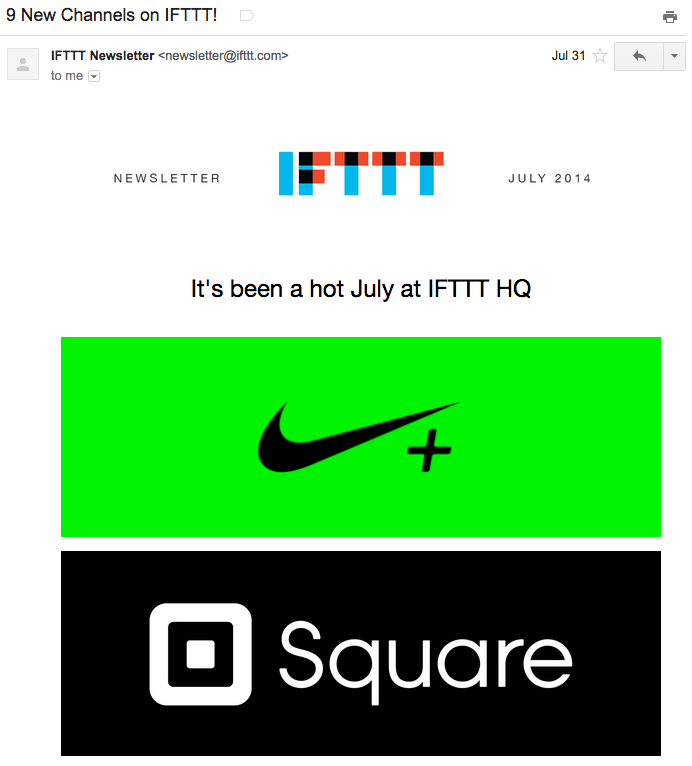
IFTTT is growing fast – they just netted a $30 million investment – but Nike is far bigger. In fact, Forbes ranks Nike as the world's 24th most valuable brand. If you can use their brand power to boost your own, why wouldn't you? Notice also that IFTTT lets images do the talking for them. The example newsletter below contains just eight words. We asked IFTTT co-founder Alexander Tibbets about the strategy and he explained that each recipe has a story that can be told with imagery.Â
We love to show rather than tell. IFTTT is designed to be a visually engaging experience, so it's only natural to approach our newsletter in the same way.
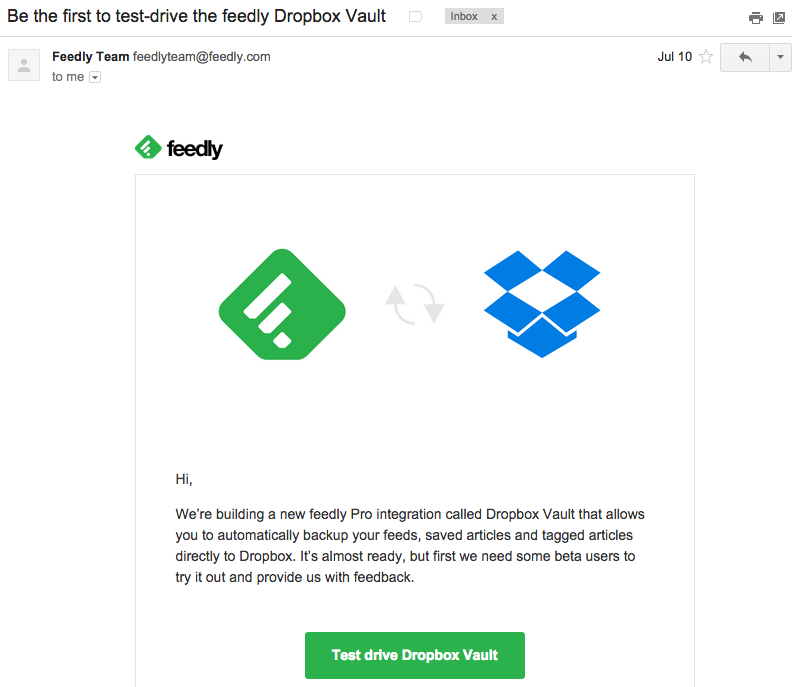
Feedly did this and invited users to join an exclusive club of beta testers. Well done.
Tip 16 Make people happy
Generosity is one of the most overlooked email marketing tactics.
It's not that hard to make people happy. How many assets do you have that you could use to make an email recipient's day a little brighter? If you aren't ready to give something away, simply say something nice, tell an uplifting story or just ask how they are.
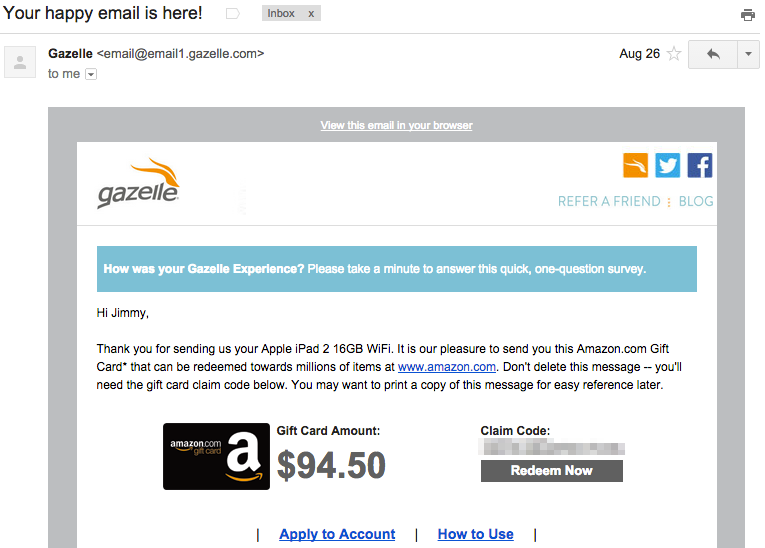
This email from Gazelle is a great example of a transactional email with a marketing twist. Gazelle owes me $94, so it's going to be easy to make me happy, but they took the time build excitement into the email. The subject line – "Your happy email is here!" – would catch anyone's attention and the bold treatment of the dollar amount reinforces just how valuable this email is.
Notice, also, that they included a referral link and a one-question survey. This is how transactional emails are done.
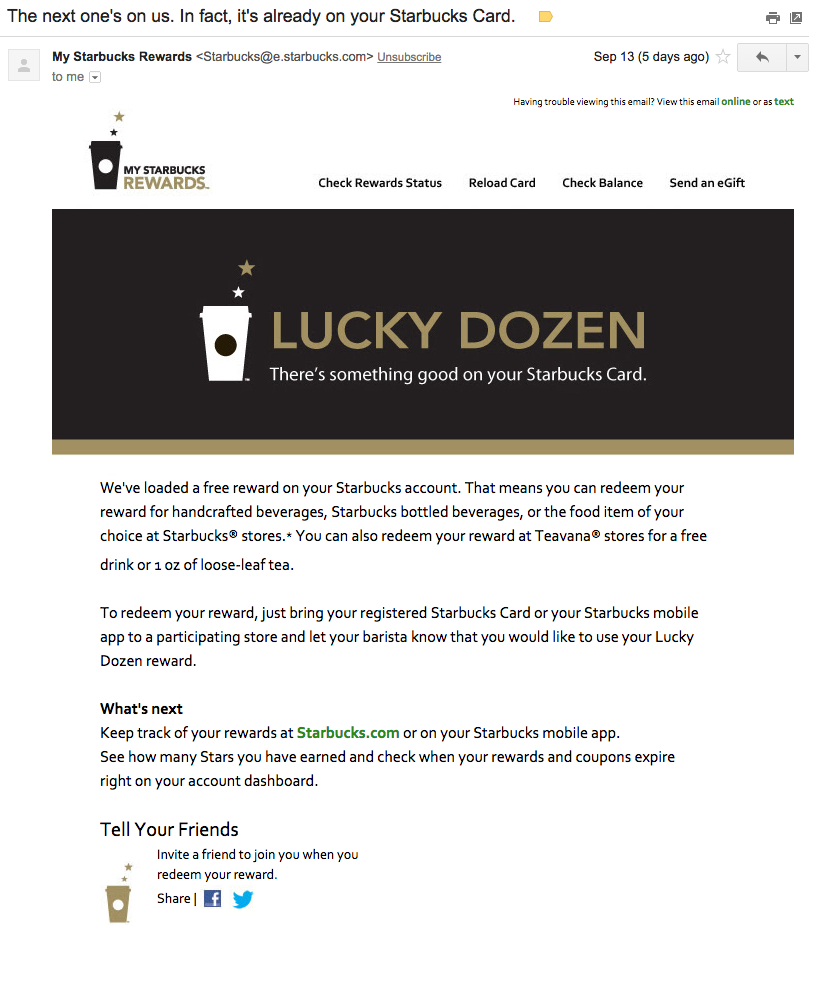
Starbucks is great at this as well. For every 12 drinks you buy, you get one free and this is the email they send. Again, it's a transactional email chock full of email best practices. Look at all the other tactics it employs:
- Includes referral link (#11)
- Tells me what to do next (#8)
- Delights the recipient (#16)
- Reminds me that I'm part of an exclusive club (#1)
- Includes links to follow on Twitter and Facebook (#6)
Tip 17 Tap into social trends and current events
Urgency can seem desperate but timeliness is always powerful.
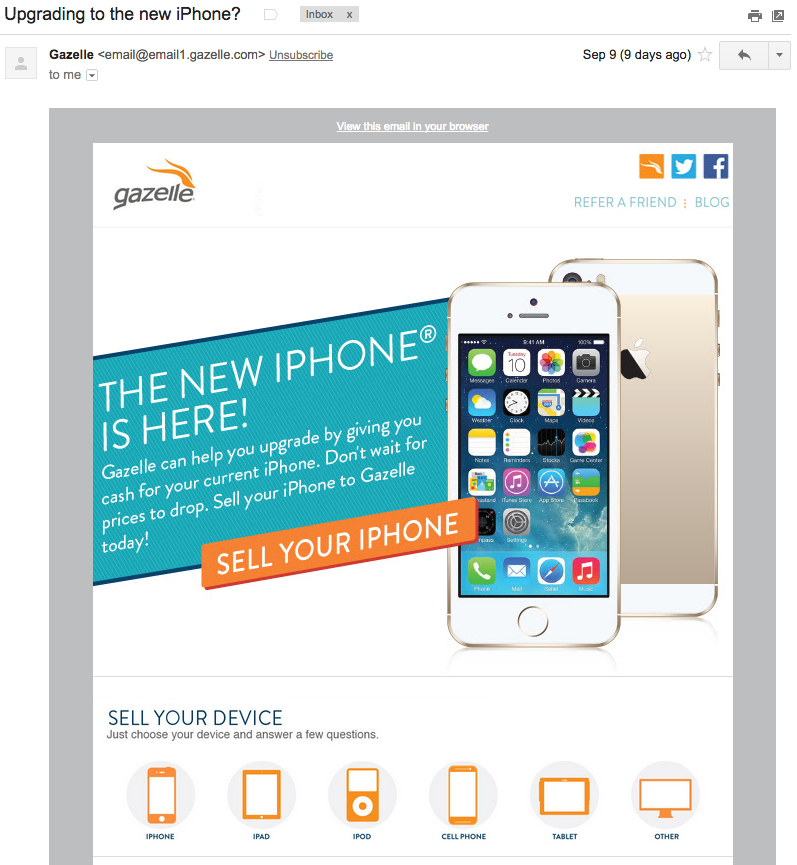
Tapping into current events or seasonal trends is a good way to encourage readers to open and click emails since their value is passing. Here's another example from Gazelle, who always uses Apple events as a marketing opportunity. Apple creates the buzz for them, and they cash in with strong offers and timely marketing.
The messaging is clear: "Help us help you."
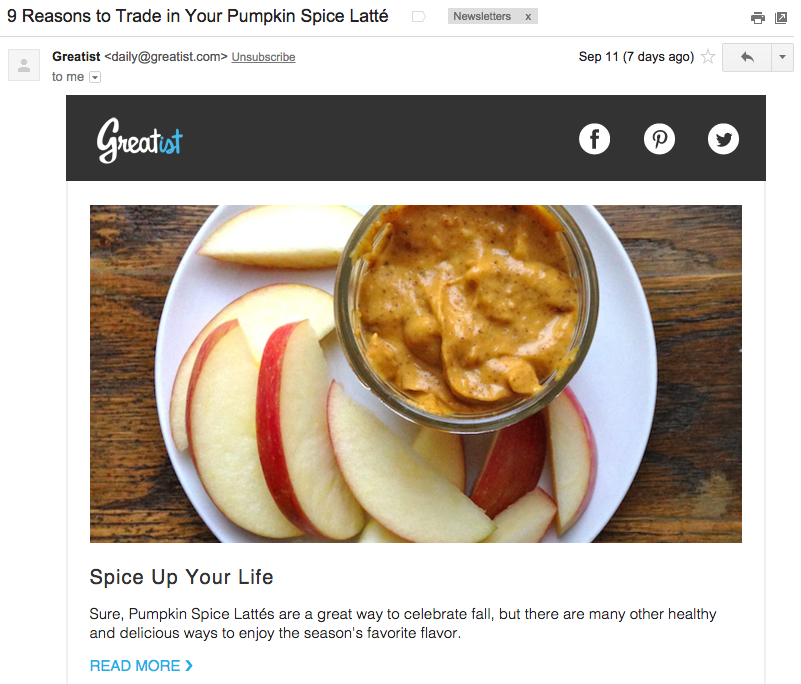
Here's another great example from the health and fitness website Greatist. Each fall, Starbucks offers the Pumpkin Spice Latte. It's extremely popular with customers (even if it's not the healthiest drink) and Starbucks makes a big deal about the limited availability of the drink. Greatist recognized the buzz as a great opportunity to offer healthier alternatives. You can't send this email in March, it only works because of season and the buzz created by Starbucks.
Tip 18 Say "thanks"
Saying is the easiest, simplest way to humanize your emails and evoke emotion in the recipient. Harvard Business Review explains why:
Saying "thank you" – sincerely and with heart – feels good. Not just to the person receiving it, but also to the person offering it. And that's part of work too. It's hard to remember, as we process our hundredth email, that behind each message is a person.
If you are grateful for your subscribers, users and customers, let them know. You don't have to dedicate an entire email to it (like the examples below) but you can build gratitude into every email you send.
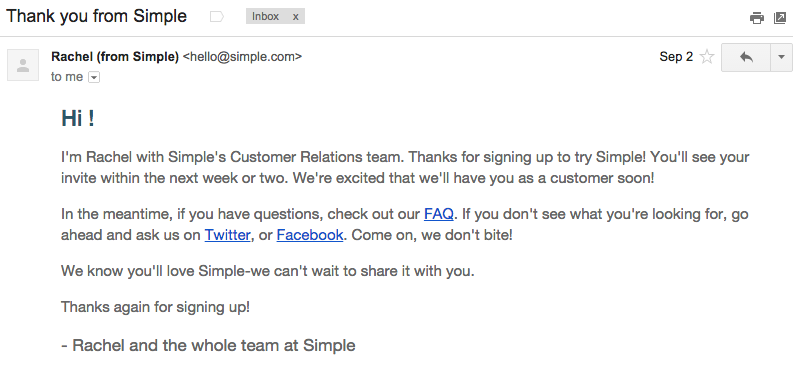
Simple, a banking service startup, sent me this email after I requested an invite to their platform. This came in place of a welcome email and it made a great first impression of the company.
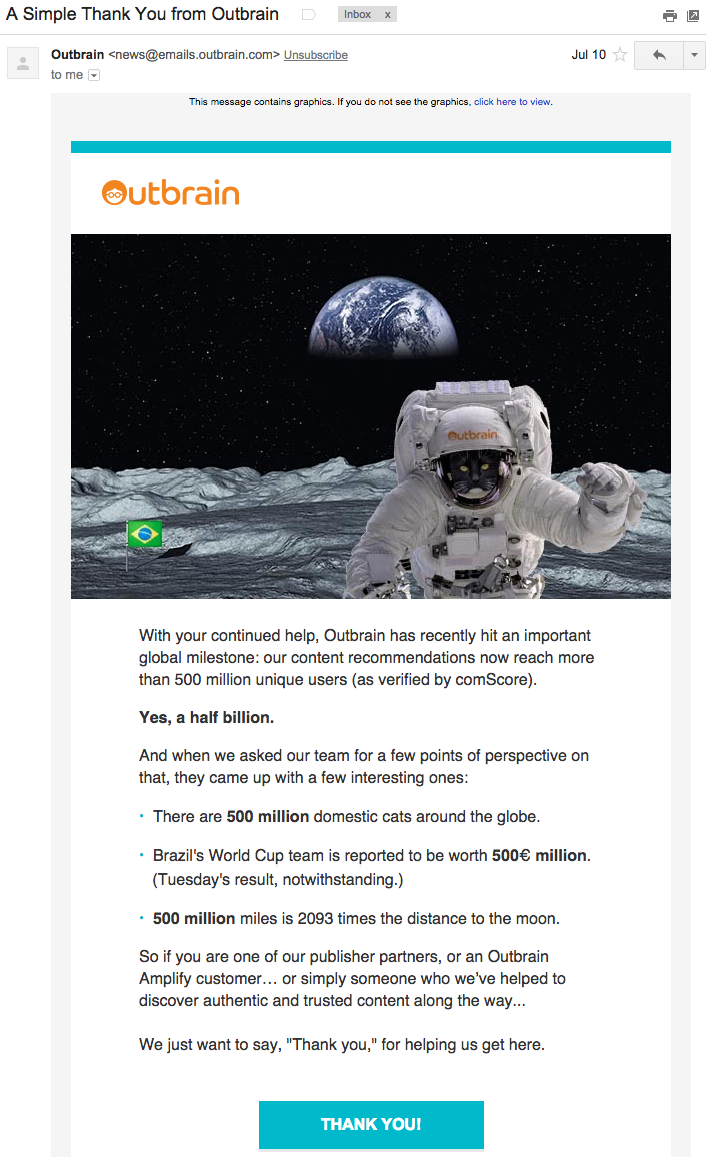
Outbrain sent me this message to let me know that their platform had reached 500 million unique users. That's an impressive milestone – and valuable social proof – that absolutely warrants an email. This message isn't designed to convert new users or drive revenue, it's simply a positive reflection of the Outbrain brand.
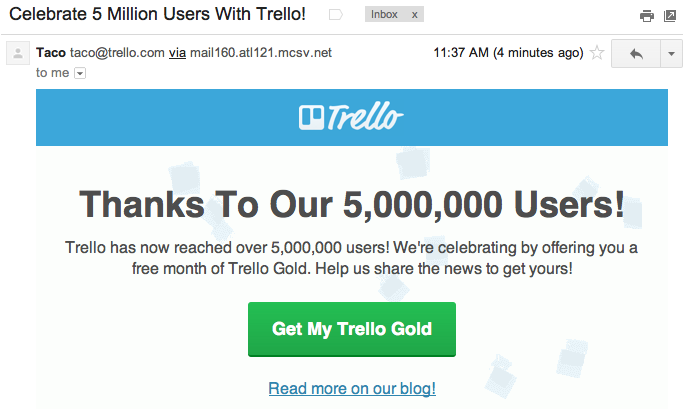
Trello recently reached 5 million users and sent this email to make the announcement. They took it a step further by offering a free month of Trello Gold, their premium level. They also incorporated a referral program to help spread the word on their achievement and their paid plans.
Tip 19 Make an announcement
Your users expect emails about product updates. The problem with most announcement emails is that they are either a) too salesy or b) too boring. Creating an email loaded with utlity and marketing value is no easy task but if you know these types of emails get opened, you need to put in the extra effort.
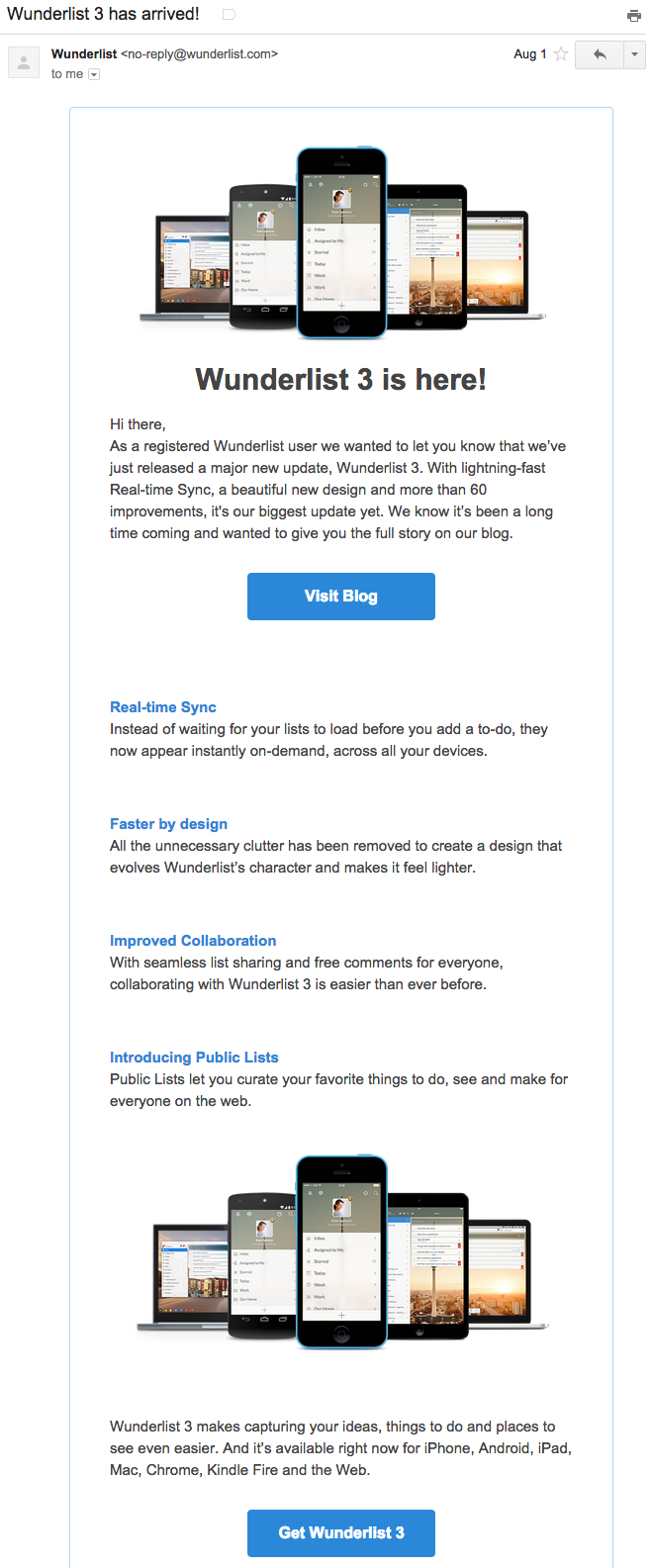
Take a look at the Wunderlist email below. The update is exciting but look at the language they use in the introduction:
As a registered Wunderlist user we wanted to let you know that we've just released a major new update, Wunderlist 3.
They are reminding the recipient that they are part of an exclusive club. The email builds on the excitement by explaining just how valuable the update is, then brings it home with a strong call to action in a bold button. (You'll notice that most of the emails in this guide are using several of our best practices.)
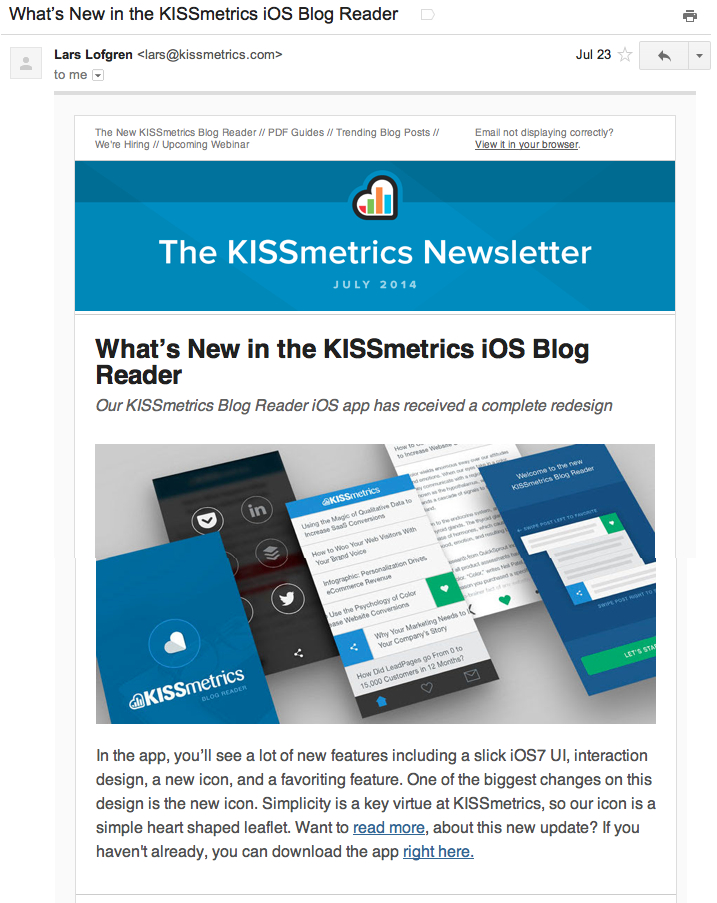
KISSmetrics take a more low-key approach. Instead of going for the "wow", it's almost like they are saying, "A brand new interface for our innovative app? No problem." Once you get to know the folks at KISSmetrics, you understand why cool products like this are an expectation.
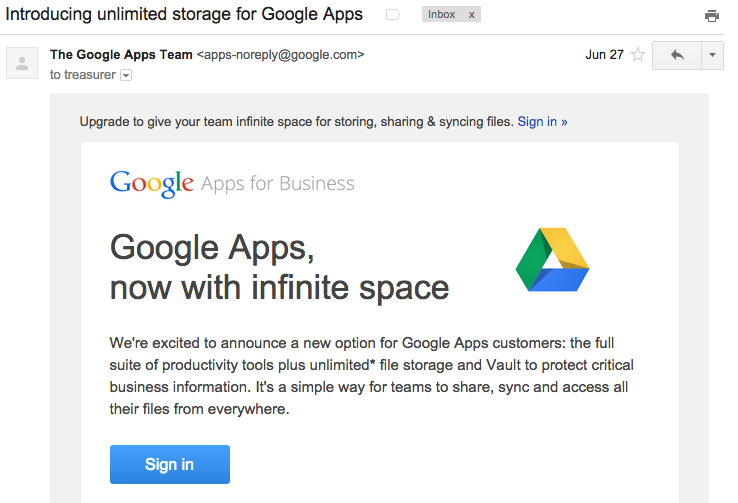
I like this example from Google Apps because it focuses entirely on value. They use impressive language like "unlimited storage" and "infinite space" to communicate that what they are offering is seriously awesome.
postach uses the introduction of their premium service as an opportunity to get early adopters in the door. They also use the email as a chance to thank the people that gave input on their tool and sign the names of each of their team members.
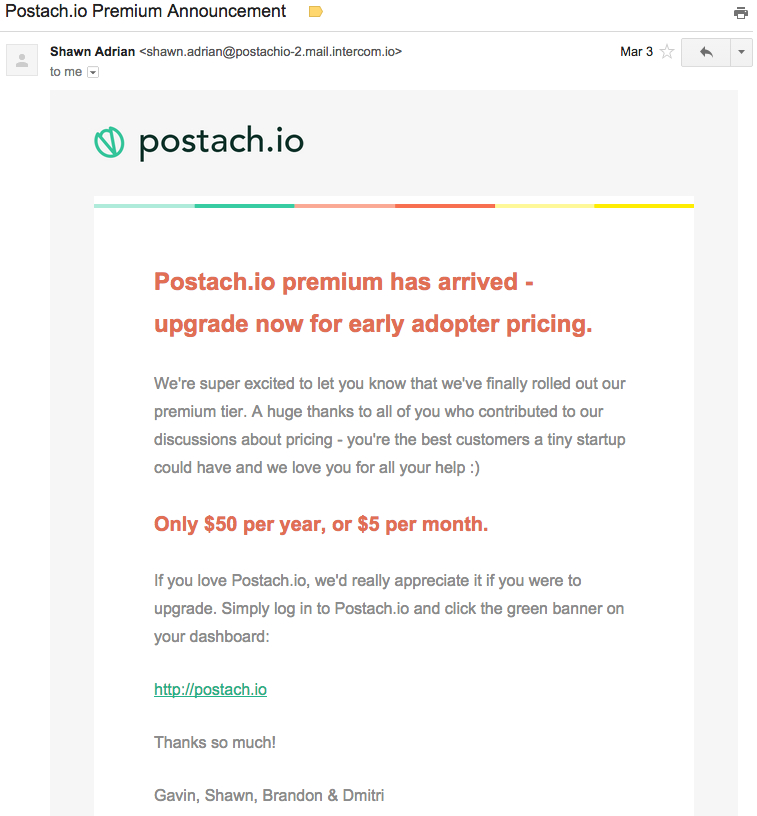
It's no accident that postach sends great emails. We reached to their Community Manager, Caleb McIntyre, who shared his five rules for crafting effective emails:
- Be personal: Speak on a first-name basis and share news as though you are just a fellow product user, not an employee.
- Be relevant: Send triggered messages based on a user's actual actions.
- Be anticipated: Don't send mass messages unless you know that each receiver can actually use the info you're sending them.
- Keep it short: Focus on quality over quantity.
- Converse: Always offer a warm invite for people to ask questions and send something back to you.
Tip 20 Gamify a process
There is a reason that video games cause some people to actually become addicted. Games, and their rewards, reinforce behavior that users want to repeat. Players earn achievements and unlock new levels, only to be sent out on new quests to earn and unlock more. There is some interesting pyschology at play here.
Marketers use gamification to attempt to turn behavior into habit. Nir Eyal, an expert on habits and behavior, has written extensively on behavior design:
Everyone suddenly seems interested in messing with your head. Gamification, Quantified Self, Persuasive Technology, Neuromarketing and a host of other techniques offer ways to influence behavior. At the heart of these techniques is a desire to change peoples' habits so that behavior change becomes permanent.
Read way more about that here.
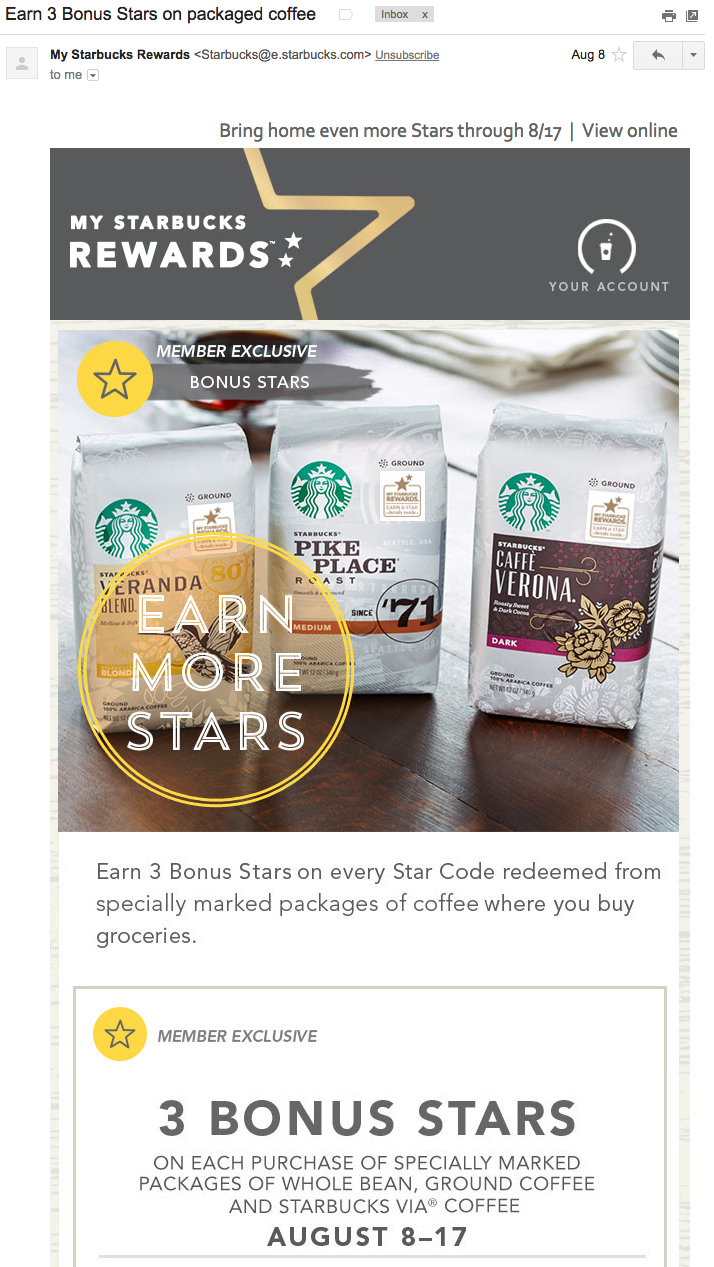
Using gamification techniques in email is an interesting way to get users in the habit of opening and engaging with email. We already talked about Starbucks use of stars to encourage custoners to buy more often. In addition to awarding stars for buying a drink in a Starbucks store, they also offer stars for other things. In the example below, they are offering three extra stars for buying a bag of Starbucks coffee at a grocery store.
The more stars, the more free drinks. Starbucks uses stars to get customers to do all kinds of things – come in after 2pm, buy a sandwich, try new products, etc.
The reason TripAdvisor is such a great website is because they've taken social proof to a new level. Reviews are the lifeblood of the site and they use gamification to encourage users to write reviews of places they've been.
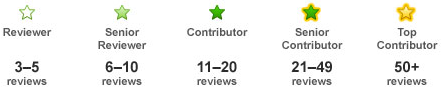
What do badges mean for users? Nothing really, minus recognition for their contribution to the community. People find TripAdvisor so helpful, however, that they write reviews to pay it forward, according to Forbes.
[Adam Medros, TripAdvisor’s VP of Global Product] says that awarding regular contributors status designations and levels cannot be over emphasized. "It is an incredibly successful and powerful program our marketing team put into place the last few years around recognizing and creating this desire to come back and keep up your status and keep contributing."
Notice that TripAdvisor taps into social proof to help convince people to contribute: "If 170 million other people have written reviews, maybe I should too."
Related Posts:

Leave a Reply

-LK, Magazine and Enewsletter Publisher