
|
    Professional Email Marketing Solutions |
Facebook Ads don't suck. But bashing them is great for marketing!
Our experts came across these previously published articles we thought you would find useful.
These are re-posts from the original sources. Author: adespresso
Enough. For the third week in a row I've just spent 2 hours on Hacker News commenting on the latest first-page post bashing Facebook Ads.
Don't be sorry for the poor guy defrauded by Facebook, however. He'll do just great. He spent $50 on Facebook Ads, got 61 clicks tracked by Google Analytics vs 92 paid to Facebook, wrote a post about it and probably received thousands of visits from Hacker News, GrowthHackers and probably other communities where bashing Facebook Ads click frauds is becoming trendy.
These types of posts are great for SEO as well! He'll receive lots of links in all future Facebook bashing posts that love to link back to similar stories for added credibility.
See, it's not that I don't believe all these guys bashing Facebook Ads — I'm not writing this post to point them out as liars. I'm pretty sure they're in good faith, and I'm sure the numbers they are sharing are genuine.
Thriving Businesses Aren't Built on Vanity Metrics
Nope, that's not the point of my response. The point is that I envy them for all the great link building & traffic they're getting for their blogs with just $50 spent in Facebook Ads and a blog post about it.
I envy them as a marketer, and to be honest, I'm writing this post to do the same thing as them. (Btw please upvote me on hacker news, would you ? :P)
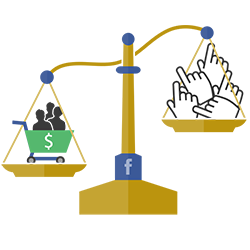
The point is that while I believe, nowadays, there are a decent amount of fraudulent clicks on Facebook Ads, I don't care. Has my campaign gotten 1, 10, 100 or 1000 fake clicks? I don't care; I don't even waste 5 minutes trying to guess the number. I don't care because my business is not built on clicks (which is ultimately a worthless vanity metric). It's built on customers, and I'd guess yours is, too.
I don't care if I'm receiving 10 visitors or 1,000; that's not what I'm advertising and paying for. I'm paying to get new customers. The only metric that really matters to me is the number of customers I got from Facebook Ads and how much I'm paying to acquire each one. As long as I'm able to earn more from new AdEspresso subscriptions than I'm spending on Facebook advertising to get those subscriptions, I'm pretty happy with it no matter how many clicks it took to get there. Clicks are only useful for us to understand the conversion rate of our landing pages and improve the number of signups we get.
Fake Clicks are Not Facebook's Gain
Most of the posts I read suggest that Facebook is aware of the problem and not doing anything about it because they get rich with advertising from fake clicks. Sorry, I don't buy it.
-
If the theory is true Facebook, would push users to pay per click (CPC). They're not. They're pushing everyone to bid with Optimized CPM. This means that you pay based on the number of impressions your ads get, not the number of clicks.
-
Facebook needs to grow its advertising business and establish it as a mature, reliable and, most of all, EFFECTIVE platform. Every time someone claims X% of the clicks are fake and make a huge blog post about it, that hurts Facebook's image and does more harm than good.
I agree that Facebook should work faster solving this issues and be more aggressive preventing fake accounts and bots. However, I think it's important to consider Facebook is a relatively new advertising platform. It always takes time to fix problems when you're dealing with business on such a large scale.
Google had its share of problems too, when it launched AdWords. Tons of users complained about click farms, resulting in a settled class action worth $90M. Give Facebook time and you'll see that the click metrics will start to make more sense.
Let's Talk About Actual Facebook Ads Data
As I said, fake clicks are not a really interesting argument for me, so I haven't spent the last month gathering data about them. However, the following data, taken from one of our Facebook Ads campaigns, may be pretty interesting to check out:
-
This data is based on a reasonable budget: $3,000.68, not $50
-
The campaign has been created by a user with a decent knowledge in FB Ads, not from a total beginner
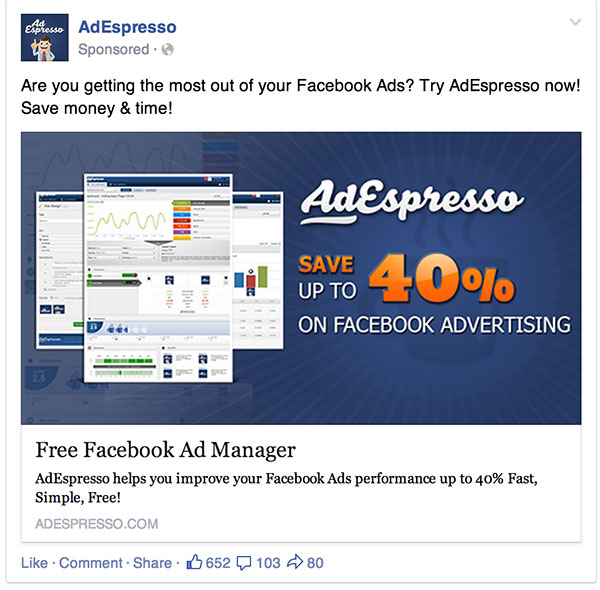
Yet, let me say this again: don't take this data for granted. It's not an analysis on $100M worth of spending. You should also run your own tests and see how any advertising channel works for your business. Here's our Ad:
Finally it's important to remember remember you'll hardly ever find two different tracking platforms returning the same data. Because there are so many variables in play, you'll always find discrepancies no matter what platforms you use. Just pick one platform and stick to it.
Let's see the numbers!
Dataset: 1 campaign from the 15th of February to the 8th of April.
Placement: Newsfeed Desktop only (no risk to have slow mobile connections or erroneous clicks)
Targeting: Highly relevant Custom Audience
Bidding: oCPM optimized for website conversion
Facebook Data

- 2,683 Clicks
- 2,039 Unique Clicks
- 1,095 Website Clicks
- 190 Conversion
- 529 Post Likes
- 65 Post comments
- 39 post shares
Screw Clicks and Unique Clicks. It's too broad and includes people clicking on the page name, on the Like button, etc. It's of no use to us. The interesting metrics are the Website Clicks and the Conversions. Unfortunately, we don't know the number of unique website clicks, but we can assume it's lower as the campaign ran for a long period.
Also, check out the social engagement … it's pretty good. Not only did people subscribe to AdEspresso, they also liked the ad so much that it was shared 39 times and received many likes and comments.
Google Analytics Data

- 1,389 Visits
- 173 Conversions
Wow … this is pretty strange. I would have honestly expected to see a number of visits lower than Facebook's reported number of Website Clicks, but here we have a whopping +26.85% … strange!
On the other side, the reported conversions are a bit lower. This is probably due to how a conversion is attributed to a source on Facebook and Google Analytics.
Double Checking the data with MixPanel

- 1475 Clicks
- 1200 Visits
- 176 Conversions
As promised, this data doesn't match with Google Analytics or Facebook. The number of reported clicks is slightly higher, and so are the conversions.
Nothing shocking in here. Just a confirmation that our campaign received way more clicks than reported by Facebook
Triple Checking Our Data with Nginx Logs
I know you're data hungry, so let's see what we have logged on the lowest level possible: our web server's logs.
- 2,046 total requests to the landing page with the campaign's tags
- 1,500 requests with referral
- 1,059 unique ip requests with referral
The number of total requests (2,046) is really high here. However, digging into the log we saw that 546 requests had no referral. Those are probably bots, spiders and other crap that probably did not have Javascript enabled to be tracked by Google Analytics and Mix Panel.
Filtering them out, we have 1,500 clicks and 1,059 unique ip/visitors. The click number is pretty near Mix Panel, so we can assume that all those people really came to our website through Facebook Ads.
Analyzing It All
So, that's a pretty strange data set — one I had not imagined. Instead of seeing fewer visits in Google Analytics than in Facebook, it's the opposite.
How is that? I don't know for sure (and remember: I don't care that much), but I can speculate just for the sake of it.
Our Newsfeed Ads were extremely well targeted using Custom Audiences. People not only clicked on it, but, as you can remember, liked the post, commented and shared it. All those interactions ended up in the user's Facebook feed and it's very likely that many of their friends saw it.
Since the Ad was well targeted to people interested in Facebook Ads Tools, these people probably had friends in the same industry and with similar interests. They clicked on our ad not because we paid for it but because they saw their friends liking/commenting/sharing it … Free organic traffic! And free conversions (probably)! Rember Facebook is a Social Network after all … take advantage of it!
We're pretty sure about the social effect of our Facebook Ads because when we checked the web server logs, we found visits to that URL coming from Twitter as well. Someone probably tweeted our landing page after clicking on the ads.
We also tried to find a way to understand how many clicks came from paid advertising and how many from organic by analyzing the web server referral log. It was a mixed bag and we could not get a real meaning out of it. Around 535 hits came from a very long referral that seems strictly relate to Facebook ads:
AE%2BJoin%2B-%2BCA%2B-%2BAdvertising%2BMarketing&h=SAQEr8YzUAQErQAcaiIw0yW56IOwz1zJ3WY1_mvPQvKmwww&enc=AZPbmiEsPzLjtWselrGl9IWPUYlOAWTQE2hpWx-A1QdYMR8GG07NyF4hG_TDRqTe72faRXX3DZD3VbPy1jUa9emRPCRUZ155-JfoUr5TJZKe69LK2pK3-JmyK4e85H7etJpkSjOBlrAE1_5per09pfLobJ3GEIC6Oab1ORzLxEJdXw&s=1
Another 965 hits came from a plain "" referral. These is probably where the organic traffic is, but it's hard to believe all of it was organic. As far as we could determine, the longer referral url is rewritten in Javascript when you click on an ad; however, the href parameter of the link still points to the clean url with no redirection.
There are too many variables at play here to be completely sure how to interpret this data. The only interesting thing here is that if you create an interesting ad targeted to an highly interested audience, not only is the effect of fake clicks irrelevant, you can even get much more traffic and leads than you paid for.
What Does This Mean for Your Business?
Now that we've watched some data-porn, let's get back to the focus of this article.
No matter what the web server logs say and how many clicks may or may not be fakes, if you want to seriously advertise on Facebook (like any other channel for what matter) you must:
-
Allocate a decent budget to test the new channel. This is both to have reliable data and to have time to learn how to get the most out of your advertising
-
Use Google Analytics utm parameters to better track your data.
-
Use conversion tracking. Whatever you're promoting — a newsletter signup, a subscription, an eCommerce website, a Mobile app install — track your main conversion!
- Target highly relevant audiences that are very likely to be interested in your products
These are the basics. If you want to go a step further, you can also track post conversion engagement. Are the users who installed your app using it? Are they trying your product after signing up for your trial?
Every system has errors, imperfections and people exploiting it in bad ways. It's frustrating, but we all have to deal with it. What really matters are our business objectives. In our case, for example, our Facebook Advertising campaigns have an average cost per acquisition that is 63% lower than Google Adwords. Conversion Rate and Bounce Rate score a victory for Facebook as well.
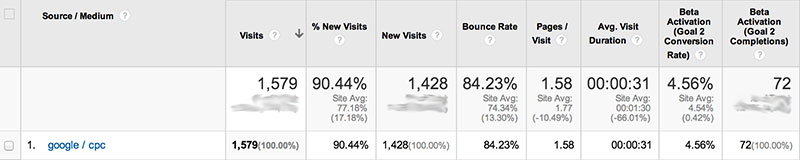
This is not to say that Facebook Ads are superior to Google Adwords, it would be like comparing oranges and apples; they are two very different platforms. It must also be noted that we at AdEspresso have far better knowledge of FB Ads than of Adwords, so we may be the problem, not the advertising channel.
However, even if Facebook has, as of now, a certain number of fake clicks, we're surely not going to stop using it because of this. Business-wise, it would simply be crazy.
There's Only One Way to Know What Works
Now that you've read lots of articles against Facebook ads and at least one pro Facebook ads, forget everything you've read so far. Go out and test! Don't rely on someone else's data. If you're serious about online marketing, allocate a reasonable budget for each channel, acquire as much knowledge as you can and test.
By the way, when I say "reasonable budget" I mean something as low as $1,000 per month — no need to spend $100,000 per day in Ads, with near-zero expertise, to attract Likes (Likes are a vanity metric, not business).
Every market, every website, and every branding strategy could work very well on some networks and horribly wrong on others. You'll find out only by testing. For example, if you are selling industrial pipes there's a good chance Pinterest is not your best channel. That doesn't mean Pinterest doesn't work, it's simply not a good fit for you.
Test, Test, Test: the advertising channel, the ad creative, the targeting, and more. Test everything and put your money where you get the best ROI, and then keep testing new ways to improve it.
Related Posts:

Leave a Reply

-LK, Magazine and Enewsletter Publisher