
|
    Professional Email Marketing Solutions |
How to Improve Your Email Marketing ROI: Starting Today
Our experts came across these previously published articles we thought you would find useful.
These are re-posts from the original sources. Author: elitegroupmarketing
When it comes to email marketing, the core question for most companies is "what is our ROI?" Despite countless blog posts proclaiming the death of email marketing – this "old fashioned" strategy is here to stay..
The fact is, there are over 3.6 billion email accounts. 91% of consumers report checking their email at least once a day, with 66% of them having made a purchase as a result of a message they received in an email.
Those are numbers that are hard to ignore.
So wringing every drop of performance and profit out of your email campaign is a smart move in the right direction – but where do you start? Let's take a closer look at the best email marketing strategies to grow your ROI, starting right now.
Make Mobile a Priority
Let's say you're an accountant in London, looking to improve your organic (natural) ranking in Google. Here's what a quick search brings up:
According to a MarketingSherpa 2013 Email marketing benchmark study, almost half of all marketers surveyed aren't checking to make sure their emails are mobile friendly:
Considering that nearly half of all emails are opened on mobile devices, and that nearly 70% of mobile users will delete an email that isn't mobile optimized, there's really no excuse for creating responsive email templates that look and function as good on a mobile device as they do on a desktop. Plugging the leak of losing mobile clicks and engagement should be your first priority.
After that, it's on to integration. You can't expect all would-be customers to land on your website and subscribe, especially considering that they're coming from multiple traffic sources. They could've discovered you on Facebook, followed you on Twitter, or even heard your ad on TV or radio. By now, most people know that having an opt-in on their website is a no-brainer.
But consider all the other opportunities:
Once you have this dual-pronged plan in action, it's time to take a closer look at the actual content of your emails:
Avoid the "Canned Response"
With email templates and newsletter services, it's all too tempting to use the default messages, including "thank you's", registration confirmations and more. This is a common area where many businesses miss out on a significant opportunity to connect. Since the subscriber is still fresh and engaged in your content – make it count.
For example, you could welcome them by giving them a tour of features, or have them watch a short video on how to use your service. If you're selling a product, let them know in advance some of the ways they can use it, and what other customers have done. Getting inspiration and motivation will further acknowledge in the customer's mind that they made the right decision. Cementing this feeling should be your primary focus at this stage.
Little-Known Relationship-Building Tactics
Moving forward into "relationship-building" status is an ongoing process that can't be completed with a few simple emails. You want to let the customer know that you care and will take the time to help answer any questions they may have. For example, sending a birthday email with a coupon is a surefire way to get your prospect back in the virtual door.
Other often-missed opportunities include:
• Shopping Cart Abandonment Reminders – Your customer may have accidentally closed a tab or went comparison shopping and left items in their cart. A quick email reminding them of their cart items along with a little incentive (Free shipping is a great one!) will spur them to action.
• Post-purchase, Tracking and Shipping Notifications – Ho-hum, your package has shipped. Here's your tracking number. Yawn. Let your customer know that you can't wait to deliver their brand new widget, and that they've made a solid decision in choosing your company because of your commitment to quality. Remind them about your return/exchange/refund policy and that customer support is always just a click away.
• Wish List Updates – The wish list is an often underutilized feature on most e-commerce sites, and it represents a prime opportunity to connect with your customer. Let them know that the price has dropped on the item they added, or that a newer model has just been released, but supplies are limited and they should act quickly if they want to buy.
• Tell-a-Friend – If a customer emails, tweets, likes or shares your product page with a friend, it's their way of saying "I really like this, and I want you to know about it". It's perhaps the highest online compliment you can receive – so why remain silent? If the friend ends up purchasing the item, why not reward both the sender and receiver? Sender gets a $5 gift card to use on their next purchase, while the friend enjoys free shipping. It's a win-win.
Embrace the Unsubscribe
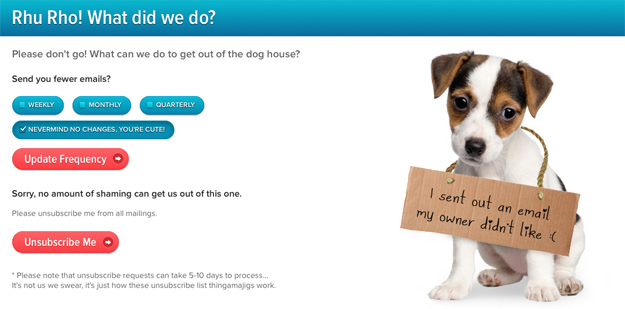
You may think of an unsubscribe as the worst possible thing that could happen to your list, but in the customer's mind, it may be the only option they have. The typical unsubscribe page is a bland, boring page with a simple confirmation, when it could be so much more. For instance:
• Your customer may want to simply change the email address they get notifications from, or change the frequency of emails or even what particular notifications they get. Give them the facilities needed to do this before you let them go for good.
• Provide them with alternative options, such as offline or social-only updates if they'd rather have a different channel to receive your updates. If you have an app, offer to let the customer download it and get push notifications on their phone.
• Perhaps most importantly, ask them why they unsubscribed. Good customer feedback can reveal major disconnects between your message and your audience, that you may never have considered or technical errors you didn't know about. Finally, thank them for being a subscriber and offer them a "going away present" – such as a free ebook, coupon, or amount off their next purchase, to show that you'll miss them and you value their patronage.
Keep Your List Clean
Getting the most out of your return on investment in email marketing means keeping your finger on the pulse of your list. Email addresses change, people's interests and priorities shift, and your list is right in the middle of it all. By segmenting users based on their purchase, age range, geographic location and other factors, you'll be able to more accurately tailor your email to fit their needs and expectations.
Beyond this, it's reasonable to assume that there will be some changes as your list grows. Emails bounce and people leave through no fault of your own. Monitoring and managing open rates, click-throughs, and revenue earned per email (by way of product sales). In many cases, emailing your list and asking them to update their preferences (change frequency, change the type of updates) may result in a sharp dive in the number of subscribers, but a strong uptick in conversion rates and ROI, because you're targeting the people who want to be targeted.
The Bottom Line on Email Marketing ROI
Improving your email marketing ROI is about more than just crunching numbers. It's about creating a seamless experience from the moment a customer opts-in, until they check out – and beyond. It's about building relationships, sending out communications that matter, and providing unparalleled support and tips every step of the way. What are some of the ways you've successfully increased your email marketing ROI?
Related Posts:

Leave a Reply

-SL, Association VP